




















For growing ecommerce businesses, hosting infrastructure is not a background concern: it directly affects page load speed, checkout reliability, security, and conversion rates. A dedicated server gives your online store exclusive access to physical hardware, delivering the performance, security, and control that shared hosting and VPS solutions cannot reliably provide at scale. This guide covers what an ecommerce dedicated server is, when to upgrade, what features matter most, which server configuration to choose, and how to manage it effectively. If you are still evaluating whether a dedicated server is right for you, our do I need a dedicated server guide provides a clear decision framework.
Key Takeaways
- A dedicated server gives your ecommerce store exclusive hardware resources, full root access, and the security isolation required for PCI DSS compliance.
- The critical features for ecommerce hosting are: NVMe SSD storage, sufficient RAM for database caching, DDoS protection, reliable uptime, and SSL certificate support.
- Dedicated servers consistently outperform shared hosting and VPS on database-heavy ecommerce platforms like WooCommerce, Magento, and PrestaShop.
- Managing an ecommerce dedicated server requires regular software updates, backup automation, performance monitoring, and security audits.
What Is an Ecommerce Dedicated Server?
An ecommerce dedicated server is a physical machine in a data centre allocated exclusively to your online store. Unlike shared hosting (where hundreds of stores share the same hardware) or a VPS (where a physical server is divided into virtual machines), a dedicated server gives your store all its CPU cores, all its RAM, and all its storage I/O. No shared resources, no neighbouring tenants who could affect your performance, and no virtualisation overhead between your application and the hardware.
For ecommerce, this distinction is critical. Your store's performance directly affects sales: a one-second delay in page load time can reduce conversions by up to 7%. Database-heavy platforms like Magento, WooCommerce, and PrestaShop are particularly sensitive to the CPU, RAM, and I/O consistency that only bare metal hardware can reliably provide.
Benefits of Dedicated Servers for Ecommerce
Consistent performance under load
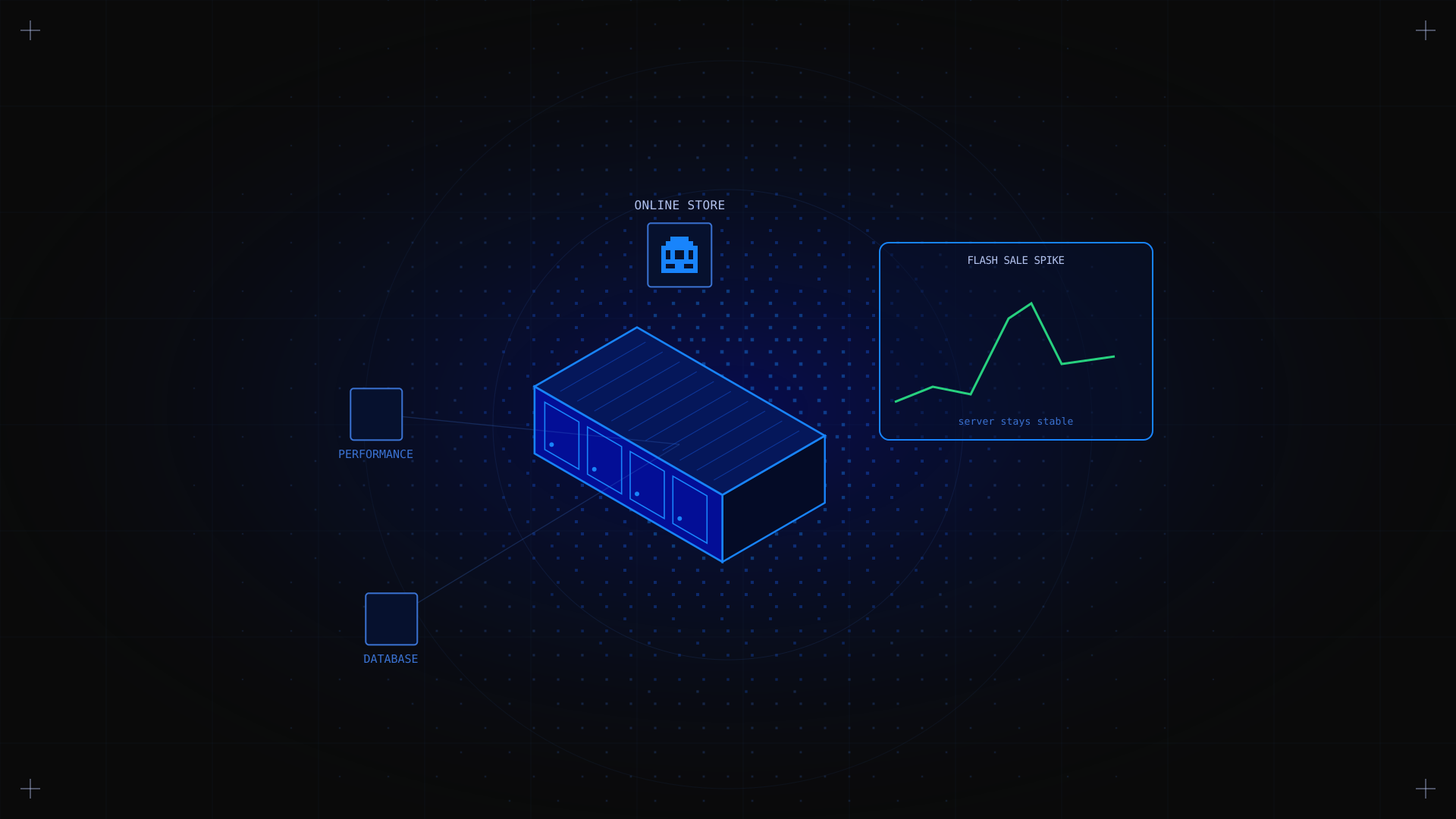
Ecommerce traffic is rarely uniform. Flash sales, seasonal peaks, and marketing campaigns can multiply your traffic in minutes. On shared hosting, this congestion means slow product pages and failed checkouts. On a dedicated server, your resources are guaranteed regardless of load: all CPU cores and RAM are yours, and a traffic spike from a flash sale affects only your own store, not your server's capacity.
Enhanced security and PCI DSS compliance
Every online store that processes card payments must meet PCI DSS requirements. A dedicated server provides the physical isolation and access control that compliance demands: no shared server environment, no other tenants with access to the underlying hardware, and full control over your firewall rules, encryption configuration, and access policies. You control who can access the server and what security measures are in place, without relying on a shared infrastructure provider.
Faster load times with NVMe SSD storage
Ecommerce platforms are database-intensive. Every product page, search query, and cart update triggers multiple database reads and writes. NVMe SSD storage delivers read speeds of 3,000 to 7,000 MB/s and sub-millisecond latency, compared to 500 to 600 MB/s for SATA SSD. For a Magento or WooCommerce store with thousands of SKUs, this difference is directly measurable in time-to-first-byte and page load speed.
Protection against DDoS attacks
Ecommerce stores are high-value targets for DDoS attacks, particularly during peak sales periods. All Kimsufi dedicated servers include OVHcloud's built-in anti-DDoS protection at no additional cost. Traffic scrubbing happens at the network edge before it reaches your server, protecting your store from volumetric attacks without any configuration required on your part.
Reliable backup and data protection
Customer data, order history, and product catalogues are critical business assets. A dedicated server gives you complete control over your backup strategy: automated daily backups with rsync or BorgBackup, database snapshots, and offsite storage.
Our dedicated server backup guide walks through a production-ready backup setup you can implement on any Kimsufi server.
Scalability and control
As your store grows, a dedicated server scales with it. Add more RAM, upgrade to a higher-tier plan, implement Redis caching, or distribute traffic across multiple servers: the infrastructure adapts to your business requirements. You are not constrained by the limitations of a shared environment or a provider's predefined resource tiers.
When should you Upgrade to a Dedicated Server for Ecommerce?
Most online stores start on shared hosting or a VPS. The right time to upgrade is when your current environment is limiting your store's performance, security, or growth. Here are the concrete signals to watch for.
For a broader decision framework, see our guide on upgrading from VPS to dedicated.
- Slow page load times under traffic: if product pages and checkout slow down noticeably during peak hours, your hosting environment is hitting resource limits.
- Checkout failures or 503 errors: resource exhaustion on shared hosting causes checkout errors that cost real sales.
- Growing traffic: stores consistently receiving more than 20,000 monthly visitors on dynamic pages benefit from dedicated resources.
- PCI DSS compliance requirements: card payment processing in a compliant environment requires isolated, controlled infrastructure.
- Magento or large WooCommerce: resource-intensive ecommerce platforms need consistent CPU and RAM that VPS plans cannot reliably provide.
- Security concerns: sensitive customer data and payment information require the highest level of server isolation.
Ecommerce Hosting: Comparing your options
| Hosting type | Best for | Limitations |
|---|---|---|
| Shared hosting | New stores under 1,000 monthly visitors, low traffic | Shared CPU and RAM, no root access, performance degrades under load |
| VPS hosting | Growing stores from 1,000 to 20,000 monthly visitors | Shared physical hardware, hypervisor overhead, CPU steal under load |
| Dedicated server | Established stores from 20,000+ monthly visitors, PCI DSS environments | Requires Linux administration skills or managed hosting |
| Cloud (IaaS) | Highly variable traffic, auto-scaling required | Variable costs, hypervisor overhead, more complex infrastructure |
For ecommerce businesses experiencing consistent growth, a dedicated server is the natural progression. The performance advantage over VPS is most pronounced on database-heavy operations, which are the core workload of any serious online store.
What Features to Look for in a Dedicated Server for Ecommerce
NVMe SSD storage
NVMe storage is non-negotiable for a database-heavy ecommerce platform. The difference in I/O latency between NVMe and SATA SSD is measurable in your store's response times under load. Look for servers with NVMe storage as standard, not as a premium add-on.
Sufficient RAM for database caching
Ecommerce databases benefit enormously from RAM caching. When your database's working dataset fits in memory (via the MySQL InnoDB buffer pool or PostgreSQL shared_buffers), disk reads are eliminated for frequent queries. For a medium-sized WooCommerce store, 32 GB RAM is a practical starting point. For large Magento deployments with extensive product catalogues, 64 GB or more allows full caching of the dataset.
Unmetered bandwidth
Ecommerce stores generate significant outbound traffic: product images, CSS, JavaScript, and API responses. A bandwidth cap creates unpredictable costs during peak periods. Kimsufi dedicated servers include unmetered bandwidth on their uplink, which eliminates surprise charges regardless of how much traffic your store generates.
DDoS protection
Infrastructure-level DDoS protection is a critical requirement for any online store. An attack that takes your checkout offline during a peak sales period is a direct revenue loss. All Kimsufi servers include OVHcloud's anti-DDoS protection as standard.
Root access
Full root access lets you install and configure any software your platform requires: specific PHP versions, Redis or Memcached caching layers, Nginx with custom configurations, search engines like Elasticsearch (required for Magento 2), and security tools. Shared hosting environments restrict these capabilities; a dedicated server removes all such limitations.
Reliable uptime SLA
Downtime for an ecommerce store is direct revenue loss. Kimsufi servers run on OVHcloud's global infrastructure with hardware-level SLA coverage: data centres with redundant power, N+1 UPS, and diesel generators. Hardware replacements are handled by OVHcloud's data centre teams without action required from you.
Which Dedicated Server Is Best for Ecommerce? Kimsufi Pricing
The right configuration depends on your store's traffic, the platform you use, and how much of your database fits in RAM. Here is a practical guide to Kimsufi's ranges for ecommerce:
| Range | Starting price | RAM | Storage | Best for |
|---|---|---|---|---|
| KS | $11.10/mo | 16–32 GB | SSD | Small stores, dev/staging environments |
| SYS | $33.20/mo | 32–64 GB | NVMe SSD | Medium stores, WooCommerce, Magento |
| RISE | $61.20/mo | 64–192 GB | NVMe SSD RAID | High-traffic stores, large Magento, B2B platforms |
All plans include unmetered bandwidth, built-in DDoS protection, root access, and KVM over IP. No setup fees on most configurations. Monthly billing with no long-term commitment. Browse KS, SYS, and RISE ranges to compare configurations.
What is the best platform to host an Ecommerce site on a Dedicated Server?
WooCommerce (WordPress)
WooCommerce is the most widely deployed ecommerce platform globally. It runs on PHP and MySQL, and benefits significantly from Redis object caching and an NVMe SSD-backed database. On a dedicated server, you configure Nginx (or Apache), PHP-FPM, MariaDB, and Redis directly, with no shared hosting restrictions. A SYS server with 32 to 64 GB RAM is well suited for medium-to-large WooCommerce stores.
Magento / Adobe Commerce
Magento is resource-intensive by design. It requires Elasticsearch or OpenSearch for its product search, Redis for session and cache management, and significant RAM for the database. Shared hosting is fundamentally incompatible with Magento at any meaningful scale. A dedicated server with NVMe RAID storage and 64 to 128 GB RAM handles Magento production deployments reliably. A RISE configuration is the recommended choice for large catalogues and high traffic.
PrestaShop
PrestaShop is lighter than Magento and runs well on mid-range dedicated hardware. A SYS server provides a solid foundation for PrestaShop stores with substantial product catalogues and moderate-to-high traffic.
Custom and headless ecommerce
Headless ecommerce architectures (React/Next.js storefronts with API-driven backends) benefit from dedicated servers for the API layer, where consistent response times and low latency matter most. A dedicated server gives you the flexibility to run any technology stack without restrictions.
How to choose a Dedicated Server Provider for Ecommerce
When evaluating hosting providers for an ecommerce dedicated server, the criteria that matter most are:
- Hardware quality: server-grade processors (Intel Xeon, AMD EPYC), ECC RAM, and NVMe SSD storage are non-negotiable for production ecommerce.
- Network reliability: redundant uplinks, low latency to your target markets, and a track record of network stability.
- DDoS protection: infrastructure-level protection that does not require additional services or configuration from you.
- Data centre locations: Kimsufi offers servers in Europe (France, Germany, UK, Poland), North America (Canada), and Asia-Pacific (Australia, Singapore, India). Choose the location closest to your customer base.
- Support and SLA: clear SLA terms for hardware replacement and network uptime. Transparent pricing with no hidden fees for bandwidth, DDoS protection, or basic management tools.
- Billing flexibility: monthly billing without long-term commitment allows you to scale your infrastructure as your business grows.
How to manage a Dedicated Server for Ecommerce
Managing an ecommerce dedicated server is an ongoing responsibility.
Here are the essential management tasks. For a complete maintenance schedule, see our dedicated server maintenance guide.
Performance monitoring
Monitor PHP-FPM workers, MySQL query performance, disk I/O, and network throughput. Use tools like Netdata for real-time dashboards or New Relic for application-level performance monitoring. Watch your store's time-to-first-byte (TTFB) and database slow query log for early signs of performance degradation.
Security maintenance
Keep your OS, web server, PHP, and ecommerce platform updated. Configure UFW to restrict access to sensitive ports (database ports should never be publicly accessible). Use Let's Encrypt for SSL certificates with automatic renewal. Implement Fail2ban to block brute-force attempts. Review your firewall rules and user access policies monthly.
Caching layer
Implement Redis or Memcached for object caching to reduce database load. Configure your web server to serve static assets with long cache headers and use a CDN for globally distributed content delivery. For Magento, full-page cache with Redis dramatically reduces server load under traffic.
Automated backups
Automate daily database backups with mysqldump and file backups with rsync. Store backups in a geographically separate location (a second server or cloud object storage). Follow the 3-2-1 rule: three copies, two media types, one offsite. Test your restore process regularly.
Load management
Monitor your server under load and configure your application stack to handle traffic spikes gracefully. Implement PHP-FPM pool settings that match your server's available RAM, configure MySQL's InnoDB buffer pool to use 60 to 70% of available RAM, and use a reverse proxy (Nginx) to serve static files and manage concurrent connections efficiently.
Conclusion
An ecommerce dedicated server is the right infrastructure choice for any online store that has outgrown shared hosting or VPS, or that handles sensitive customer data requiring compliance. Dedicated hardware eliminates the performance bottlenecks of shared environments, provides the security isolation needed for PCI DSS compliance, and gives you complete control over your hosting stack.
With Kimsufi dedicated servers starting at $11.10/month and professional ecommerce configurations from $33.20/month, the upgrade is more accessible than most store owners expect. The performance improvement in load times and checkout reliability pays for itself quickly in conversion rate and customer experience.
FAQ
What is the best server for an ecommerce website?
For a growing ecommerce store, a dedicated server with NVMe SSD storage, 32 to 64 GB ECC RAM, and a modern multi-core processor is the optimal configuration. Kimsufi SYS servers from $33.20/month provide this specification at a competitive price point, with unmetered bandwidth and built-in DDoS protection included.
How does dedicated hosting improve ecommerce performance?
Dedicated hosting eliminates the three main performance bottlenecks of shared environments: CPU contention, shared RAM, and shared disk I/O. Your store gets guaranteed CPU cores for PHP processing, dedicated RAM for database caching, and exclusive NVMe I/O throughput. The result is faster page loads, lower TTFB, and more reliable checkout performance under traffic.
What is the cost of dedicated server hosting for ecommerce?
Kimsufi dedicated servers for ecommerce start at $11.10/month (KS range, suitable for smaller stores or staging environments). Production ecommerce configurations start at $33.20/month (SYS range) for medium stores. High-traffic platforms on the RISE range start at $61.20/month. All plans include unmetered bandwidth, DDoS protection, and root access with no setup fees on most configurations.
Do I need a managed dedicated server for my online store?
If you or your team have Linux administration experience, an unmanaged dedicated server (Kimsufi) is the most cost-effective option and gives you complete control. If you need the provider to handle OS updates, security patching, and server management, a managed dedicated server is available at a higher monthly cost. For teams building in-house capability, our Linux server configuration guide and dedicated server maintenance guide cover the essentials.
Is a dedicated server better than cloud hosting for ecommerce?
For ecommerce stores with consistent, predictable traffic, a dedicated server typically offers better performance per dollar than cloud hosting. Cloud hosting's advantage is elastic scalability: you can scale resources up and down on demand, which suits highly variable traffic patterns. For stores with steady growth and predictable peak periods, a dedicated server delivers more consistent performance at a lower total cost.