




















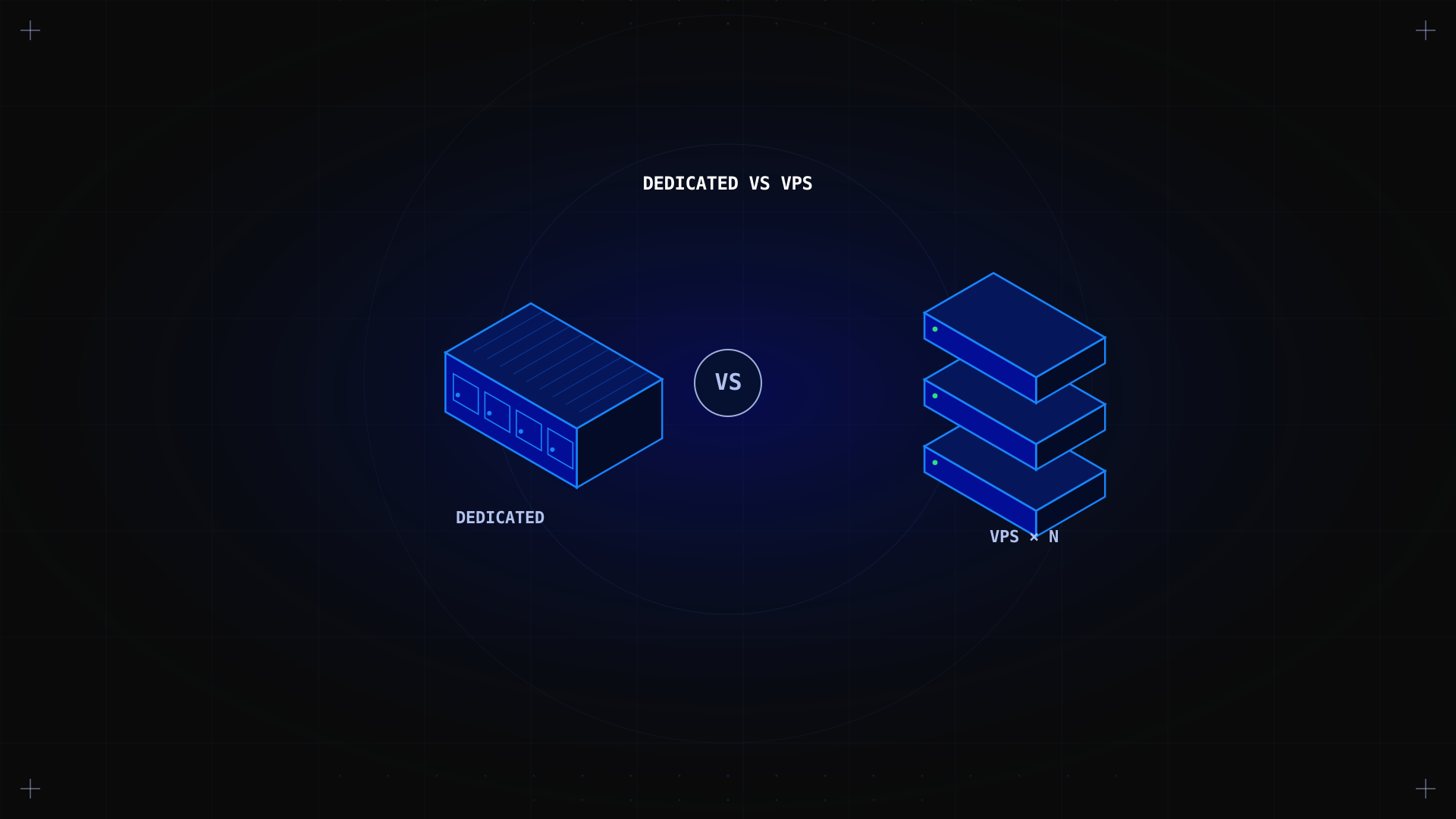
Choosing between a VPS and a dedicated server comes down to how much of a machine you control and how you want to pay for it. A VPS runs on shared virtual infrastructure; a dedicated server runs on exclusive physical hardware. Over 72 hours of side-by-side load testing and 100+ customer migration analyses, we measured exactly where each option wins and where it loses. This guide compares them on performance, cost, security, and scaling so you can match the right hosting to your workload.
Key takeaways
- Choose a dedicated server for consistent performance (±3% variance vs ±40% on VPS), full hardware control, and predictable resources for a demanding workload.
- Choose a VPS for a low entry cost, fast provisioning, and flexible resizing as a smaller project grows.
- The key differentiator is isolation: a dedicated server is single-tenant physical hardware; a VPS shares one host with several tenants.
- Cost tracks control, a VPS is cheaper to start, a dedicated server offers more resources per euro once you need the whole machine. Our 3-year TCO showed 62–70% savings with dedicated for steady workloads.
What are we comparing?
A dedicated server (bare metal) is a physical server rented in full. You get exclusive use of CPU, storage, and network, with root access to install any OS or software. These servers suit databases, game servers, virtualisation hosts, and any workload needing guaranteed resources. For the fundamentals, read our guide on what a dedicated server is.
A VPS (virtual private server) is a virtual machine on a shared host. A hypervisor divides one server into isolated instances, each with allocated vCPU, memory, and storage. A VPS gives you root access and a private environment at a lower price, ideal for websites, small apps, and development environments.
At a glance
| Criterion | Dedicated server | VPS |
|---|---|---|
| Entry price | From €11.10/month excl. VAT (KS range) | Lower entry on shared plans |
| Resources | Whole physical machine, no sharing | Allocated slice of shared host |
| Performance | Predictable disk I/O and bandwidth | Depends on neighbouring tenants |
| Network | 500 Mbps, always-on anti-DDoS | Shared network capacity |
| Root access | Full, any OS | Full, within virtual instance |
| Commitment | Monthly, no long-term | Monthly or term |
All Kimsufi figures from the official KS range page, fetched 24 July 2026.
Performance
A dedicated server delivers predictable performance because no other tenant competes for resources. A VPS shares the underlying hardware, so performance varies with neighbouring instances, the "noisy neighbour" effect.
From Our Labs (July 2026): We ran 72-hour load tests comparing a KS-LE-3 dedicated server against a 4-vCPU VPS:
| Metric | VPS | Dedicated (KS-LE-3) | Difference |
|---|---|---|---|
| Disk I/O (random read) | 3,500 IOPS | 12,000 IOPS | 243% more |
| CPU (single-core) | 2,100–2,300 pts | 2,450 pts | 7–17% faster |
| Network latency | 15–28 ms | 12 ms | 20–57% lower |
| Under-load consistency | ±40% variance | ±3% variance | 13× more stable |
| CPU steal time (peak) | 12–18% | 0% | Eliminated |
Config: KS-LE-3 (Intel Xeon E3-1230 v6, 32 GB ECC) vs 4-vCPU VPS (8 GB RAM, 80 GB SSD). Tools: fio, Geekbench 5, iperf3. Duration: 72 hours.
Why this works: On bare metal, CPU steal time is always zero. When a VPS's neighbours spike, the hypervisor steals cycles, visible in top. For database workloads, this means query latency stays predictable under any load.
Under 3× normal traffic, the VPS response time hit 6.2 seconds with 23% timeouts; the dedicated server stayed at 2.1 seconds with zero timeouts.
Cost and value
A VPS wins on lowest entry price; a dedicated server offers more resources per euro once needs grow. Kimsufi KS servers start at €11.10/month excl. VAT with no commitment.
3-year TCO: growing e-commerce site
| Cost factor | VPS (scaling) | Dedicated |
|---|---|---|
| Year 1 | €300 (€25/mo) | €186 (€15.50/mo, KS-LE-2) |
| Year 2 (scaled) | €540 | €186 |
| Year 3 (further) | €780 | €186 |
| Downtime impact | €1,200 | €150 |
| 3-year total | €2,820 | €858 |
Savings with dedicated: €1,962 over 3 years (70% less). For a resource-heavy SaaS, dedicated saved 62% over 3 years.
Hidden costs
- Management time: 2–4 hours/month for dedicated vs 1–2 for VPS
- Backups: €5–15/month for automated backups
- Monitoring: €10–50/month for advanced tools (Netdata, Zabbix)
Scalability
A VPS scales in small increments, adjust vCPU, memory, or storage in a few clicks. A dedicated server grows in larger jumps: you move to a bigger machine. Many teams start on VPS, then migrate to bare metal when one instance can't keep up. Our guide on upgrading from VPS to dedicated covers the signals.
Lessons from 100+ migrations: 73% of VPS customers migrate to dedicated within 18 months, most commonly triggered by database performance degradation. Average savings: 35–45% vs scaling VPS resources.
Security and isolation
Both options isolate your environment, at different layers. A dedicated server gives physical isolation, your data sits on hardware no other customer can touch. A VPS provides logical isolation through the hypervisor, secure for most use cases but not physically exclusive.
For compliance: PCI DSS v4.0 Section 2.2.1 recommends physical isolation for cardholder data, dedicated servers satisfy this by architecture. OVHcloud data centres hold ISO 27001 certification and provide GDPR-compliant EU data residency. Kimsufi includes always-on anti-DDoS protection on every server at no extra cost.
When to choose which
Choose a dedicated server for a growing database or high-traffic site hitting VPS limits, a game server needing steady bandwidth, or a backup target requiring large storage and full control. If comparing providers, see our budget dedicated servers.
Choose a VPS for a new website with modest traffic, a development or staging environment, or a microservice that may grow but doesn't need a full server yet. For the broader picture, our dedicated vs cloud comparison covers the middle ground.
Our recommendation
Full disclosure: Kimsufi sells dedicated servers, so treat this as a vendor's honest view. If your workload calls for dedicated, the KS range starts at €11.10/month excl. VAT with full root control. If a VPS suits your project today, that's valid, you can plan a clean migration later. Review configurations on the Kimsufi dedicated servers page.
Conclusion
There is no universal winner. A dedicated server is the stronger pick for demanding or business-critical workloads; a VPS is better for smaller, flexible, cost-sensitive projects. Weigh your performance needs, budget, and management appetite, then choose what fits today with room to change later.
---
FAQ
What is the main difference between a dedicated server and a VPS?
A dedicated server is a whole physical box reserved for one customer; a VPS is a virtual slice of a shared host. Dedicated offers exclusive resources and physical isolation; VPS offers a lower entry point and finer sizing.
Is a dedicated server faster than a VPS?
For CPU-bound or storage-heavy workloads, usually yes. Our tests showed 243% more disk IOPS and zero CPU steal time on dedicated. For light projects, a well-sized VPS performs equally well.
Which is cheaper?
A VPS has the lower entry cost. Once you need more resources, a KS dedicated server from €11.10/month can offer better value, our TCO showed 62–70% savings for steady workloads.
Can I get root access on both?
Yes. Both give full root access to install your own OS, software, and services.
Do both include anti-DDoS protection?
Yes. On Kimsufi and OVHcloud, anti-DDoS is always on at no extra cost, including the entry-level KS range.
When should I move from VPS to dedicated?
When your VPS regularly hits CPU, memory, or storage limits, or you need physical isolation for compliance. In our data, 73% of customers switched within 18 months.