


Ansible and Puppet solve the same problem: keeping a fleet of servers in a known, repeatable state instead of a pile of hand-edited boxes. They go about it in opposite ways, and in 2026 the difference between them is no longer only technical. Puppet's licensing moved, Ansible's did not. This guide compares architecture, syntax, cost, scale and migration paths, on infrastructure from $11.10/month.
Key Takeaways
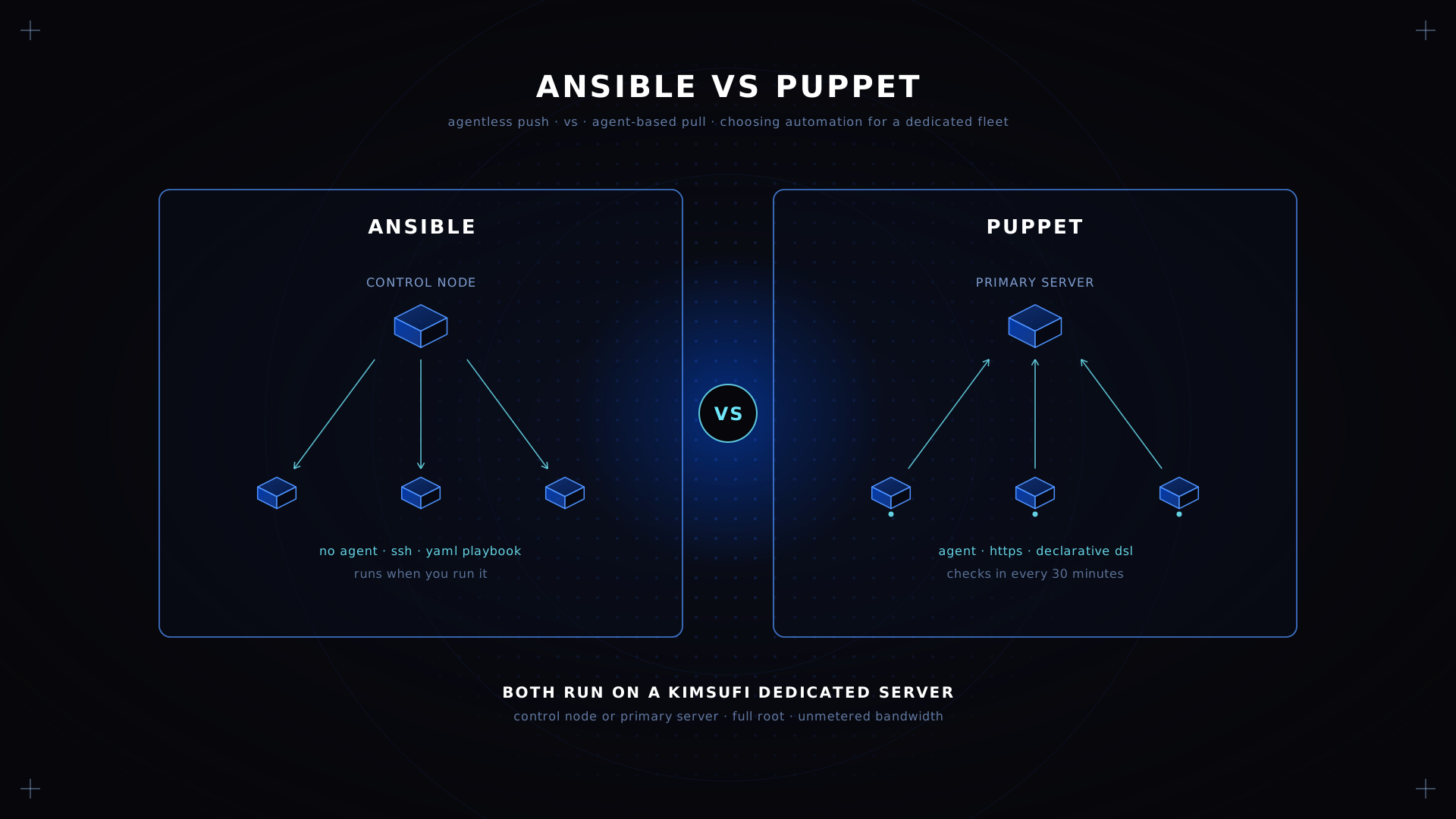
- Ansible is agentless: it connects over SSH and runs an Ansible playbook on demand. Puppet uses an agent: each host pulls its configuration on a schedule.
- Ansible uses YAML, which most teams read on day one. Puppet uses a declarative DSL: longer to learn, more precise about dependencies.
- Since 2025 the official binaries sit behind a EULA, with commercial licensing required beyond 25 nodes. The community answer is OpenVox, an Apache 2.0 fork.
- Ansible suits orchestration, application deployment and ad-hoc operations: one command can automate a configuration change across a whole tier. Puppet suits long-lived fleets where configuration drift is the main enemy.
- For one to fifty dedicated servers, Ansible is the shorter path. Puppet earns its overhead at scale and under scrutiny.
Overview of Ansible and Puppet
Puppet arrived in 2005, before the word DevOps existed. It describes infrastructure as code, compiles that description into a catalogue per host, and a daemon enforces it on a schedule. Perforce acquired it in 2022.
Ansible arrived in 2012 with a different bet: no agent, no central database, just SSH and Python on the target. Red Hat acquired it in 2015. The community package is free and each version ships openly; Ansible Automation Platform is the paid tool on top, and the version most enterprises deploy.
| col1 | Ansible | Puppet |
|---|---|---|
| Model | Push, agentless | Pull, agent base |
| Language | YAML playbooks | Puppet DSL manifests |
| Transport | SSH | HTTPS to a primary server |
| Default cadence | When you run it | Every 30 minutes |
| Free tier | Full community package | Open code, restricted binaries |
| Best at | Orchestration, app deployment | Continuous configuration enforcement |
💡 Tip Neither tool does infrastructure provisioning in the Terraform sense: both configure servers that already exist. To provision a server you need a separate step, through a cloud API or your provider's control panel.
Core Architecture: Agent-Based vs Agentless
Everything else follows from this.
Puppet uses an agent. A small daemon runs on every managed host. It wakes on a timer, sends facts to the primary server, receives a compiled catalogue, applies it and reports back. That server holds the desired configuration for every machine it manages, and hosts converge whether or not anyone is watching. That is what you want when drift is the thing you are fighting.
The cost is that daemon itself: something to install, update and keep talking to the server. Past a few hundred hosts, compile capacity and the network traffic it generates become real considerations.
Ansible is agentless. Nothing runs on the target. You execute a playbook from a control node, which opens an SSH connection, pushes the code it needs, runs it and cleans up. A new server is manageable the moment SSH works, which is why Ansible fits an app deployment workflow so easily: the same operation works on a box built this morning.
The cost is that nothing happens unless something triggers it, so drift between runs is invisible. Teams close that gap with a scheduler or a CI workflow, which works, but it is a convention rather than a property of the tool.
💡 Tip Agentless also means nothing extra to secure, a real advantage where every resident daemon is another thing to patch. Our bare-metal server with Confidential Computing page covers the wider hardening picture.
Playbooks vs Manifests: Syntax and Learning Curve
An Ansible playbook is YAML. A task names a module and its arguments, and an engineer who has never seen Ansible can read one correctly on first contact. Each module is a small, documented unit. The simple format is what gets code actually reviewed.
Ansible executes tasks in the order you write them. Execution order is easy to reason about and easy to get wrong at scale, because it is your responsibility rather than the tool's.
Puppet manifests use a declarative DSL. You describe resources and their relationships, and the tool works out the order. Dependencies are explicit, so a package, its configuration template and its service wire together, and the service will not restart before the file lands. That is its main advantage.
The DSL is the barrier: a real language with its own idioms, and teams routinely need weeks before they are productive. What you buy is precision.
In practice. Ansible is easier to pick up and harder to keep tidy across hundreds of roles. Puppet is harder to learn and holds its shape better over years, a real advantage on a codebase several teams maintain.
Performance and Scalability Benchmarks (2026)
Published benchmarks age badly and rarely match anyone's environment, so compare the shape of the curve rather than absolute figures.
Ansible runs in parallel across a configurable number of forks, and each host costs one or more SSH round trips per task. Below a hundred servers the wall-clock time is unnoticeable. Above that, people reach for pipelining, fact caching and splitting roles apart, each a scalability workaround rather than a capability you get free.
Puppet moves the work to the managed host. The central server compiles catalogues, which is the bottleneck, and each host enforces its own. Load spreads across the check-in window, so a thousand-host fleet behaves more predictably than the same fleet under a single push. Consistency comes from the schedule, not the operator.
The crossover sits in the low hundreds of hosts. Below it, simplicity wins. Above it, that architecture stops being overhead and becomes the reason the whole thing keeps working.
💡 Tip Both tools are I/O-sensitive on the control side: a server compiling catalogues benefits from fast storage more than extra cores. See our guide to storage options for dedicated servers.
Cost Comparison: Licensing, Cloud and Support
This is where 2026 looks nothing like 2022.
Ansible. The community package remains free and openly developed. Red Hat sells Ansible Automation Platform for teams that require a web UI, access control and support, but nothing forces you onto it: a large production fleet can run on the free package indefinitely.
Puppet. In late 2024 Perforce announced that new binaries would ship only to a private repository, with contributor access governed by a EULA and commercial licensing required beyond 25 nodes. The Apache 2.0 source stayed public, but official open builds stopped.
OpenVox. The Vox Pupuli community responded with a fork, first released in January 2025 and still Apache 2.0. It is the practical route for anyone who wants the same architecture without Perforce's terms, and the modules are tested against it.
| Cost factor | Ansible | Puppet |
|---|---|---|
| Free at any scale | Yes, community package | No, commercial beyond 25 nodes |
| Open source fork available | Not needed | OpenVox, Apache 2.0 |
| Paid tier | Ansible Automation Platform | Puppet Enterprise, Puppet Core |
| Hidden cost | Engineer time on ordering and structure | A primary server to run and maintain |
Infrastructure cost is small either way: a Puppet server for a modest fleet sits comfortably within a budget dedicated server, and an Ansible control host needs even less power.
Integration with Major Cloud Providers (AWS, Azure, GCP)
Both talk to cloud APIs through collections rather than anything built in. Ansible ships dynamic inventory plugins that query a cloud provider and build the host list at run time, so an instance created ten minutes ago is managed without editing a file. Puppet gets there through its own modules and node classification, and both integrate with the usual provider APIs.
For a multi cloud or hybrid cloud estate, the decisive question is not which cloud provider each tool supports, because both cover AWS, Azure and GCP adequately. It is how each behaves when a host is unreachable. Ansible skips it and reports a failure. Puppet's daemon converges whenever the host comes back, with no manual intervention.
That matters more in hybrid cloud work than any feature table: a hybrid estate mixing rented bare metal with cloud instances will have machines briefly off the network, and a scheduled check-in absorbs that gracefully. To weigh the hosting approaches themselves, see dedicated server vs cloud hosting.
💡 Tip Ansible is the more common choice for container and Docker workflows, largely because it slots into a CI pipeline as one step. Puppet can configure a Docker host perfectly well, but few teams reach for it to create images.
Use Case: When Ansible Is the Right Choice
Pick Ansible when:
- Your fleet is small to mid-sized. One to fifty servers, where an extra daemon on each host is overhead you do not need.
- You need an orchestrator, not just configuration management. A rolling restart, an ordered upgrade across tiers, a database failover: each is a sequenced operation, and Ansible's ordered execution expresses it naturally. As an orchestrator, Puppet has no good answer, which is why teams that deploy applications frequently keep Ansible around.
- You do ad-hoc operations. A single command across every web server is a one-liner, and that one capability keeps Ansible installed on boxes managed by something else.
- You cannot install anything. A network appliance, a locked-down image, a customer device: if the device takes SSH, Ansible drives it. Nothing to install, nothing to update.
- Your team is small. The learning curve is short enough that everyone can contribute, rather than one specialist owning the automation.
A typical shape: a handful of dedicated servers, one role per application, and a pipeline that runs the whole thing on merge. Simple, auditable, nothing extra to maintain. It starts with one control node and a first playbook, which our Ansible installation walkthrough covers step by step.
Use Case: When Puppet Is the Right Choice
Pick Puppet when:
- Drift is your actual problem. Hundreds of long-lived hosts that people log into. Puppet reverts a manual configuration change on the next run, automatically.
- Scale is in the hundreds or thousands. A scheduled pull spreads load and removes the control node as a bottleneck.
- You need to prove state, not just set it. Every run reports what changed, an audit artefact rather than a log line, so fleet consistency becomes something you can demonstrate.
- Your environment is long-lived. Its dependency approach keeps a large codebase coherent in a way that ordered YAML does not.
- You run heavy virtualisation. Hypervisor fleets and container hosts are exactly the long-lived, drift-prone estate it was built for; our bare-metal server for virtualisation and Kubernetes page covers the hardware side.
Security, Auditing and Compliance Features
Attack surface. Ansible adds nothing to the target, but the control node holds SSH keys to everything. Puppet adds a daemon on every host plus a central server holding the whole estate: wider surface, narrower credentials.
Audit trail. Puppet is stronger by design: each run produces a central report of every resource inspected and every change it had to make, so reconstructing what a host looked like last Tuesday is a query. With Ansible you get the output of whoever ran it, unless you add a system to keep the record.
Secrets. Ansible Vault encrypts variables in the repository; Puppet uses Hiera with eyaml. Neither replaces a dedicated secrets manager once more than one team is involved.
Compliance. If you are regulated, continuous enforcement plus reporting is the easier story to tell an auditor: the tool proves the configuration was held, not merely that someone made a change once.
Community, Ecosystem and Support Options
Ansible has the larger community by a wide margin. Galaxy hosts collections for almost anything, the documentation is robust, and the answer to most questions already exists.
Puppet has a smaller but deeper community, and its Forge modules tend to be more thoroughly engineered because the DSL rewards it. Since 2025 that community splits in two: Perforce's Core and Enterprise editions on one side, OpenVox and the Vox Pupuli ecosystem on the other.
That split is the biggest change in this comparison. It does not make Puppet a bad tool, but a team choosing it in 2026 also chooses which flavour, with licensing consequences Ansible users never face.
Migration Paths and Hybrid Automation Scenarios
There is no converter between a manifest and a playbook. Plan the move as a rewrite.
Puppet to Ansible. Work role by role, not host by host. Take one class, write the equivalent playbook, run it against a staging host, compare the result, then cut that role over. Both tools coexist happily as long as they do not manage the same file.
Ansible to Puppet. Rarer, usually driven by scale or compliance. Start with the configuration every host shares, get the server and agents working on that, then move roles one at a time.
Running both. Common and entirely workable. Puppet holds the baseline configuration on every host; Ansible handles the app deployment, the orchestration and anything ad-hoc. The rule is strict ownership: each file or service depends on exactly one tool. Break that rule and the two will fight, each reverting the other, with results that are miserable to debug.
💡 Tip Agents reporting in on a schedule generate steady background traffic: modest per host, easy to forget at scale. Our guide to high bandwidth vs unmetered dedicated servers explains when it begins to matter.
Final Recommendation: Which Tool Wins for Your Needs
There is no winner, only a fit.
Choose Ansible if you run fewer than a hundred servers, want to be productive this week, need to deploy applications as well as manage configuration, or want to avoid a licensing question entirely. For most teams reading this, that is the answer.
Choose Puppet if you run hundreds of long-lived hosts, drift is your daily problem, or an auditor needs proof of enforced state. Then pick the flavour deliberately: OpenVox for Apache 2.0, Enterprise for a vendor contract.
Choose both if you are already large enough to have the problem each one solves: Puppet for the baseline, Ansible for every application on top.
Conclusion
Ansible and Puppet answer the same question with opposite architectures, and in 2026 licensing is as decisive as the technical comparison. Ansible is agentless, free and quick to learn, the default for small and mid-sized fleets. Puppet is stronger at enforcing and proving configuration across hundreds of long-lived hosts, at the cost of a steeper DSL and a licensing decision that now has to be made consciously. Either way, both need somewhere predictable to run: a small, always-on machine where consistent performance matters more than raw power.
Run your automation on bare metal Get started with Kimsufi dedicated servers from $11.10/month. Root access, unmetered bandwidth, built-in DDoS protection.
FAQ
Is Ansible still relevant in 2026?
Yes. It remains the most widely used configuration management tool, the community package is still free, and Red Hat keeps shipping Ansible Automation Platform releases. The licensing changes elsewhere have pushed more teams toward it.
What is replacing Ansible?
Nothing, in the sense the question implies. Terraform and OpenTofu took infrastructure provisioning, and container orchestration took a slice of application deployment, but neither replaces configuring an operating system on a running server. Ansible's territory narrowed; it did not disappear.
Do people still use Ansible?
Widely, across every size of organisation. It is the default answer for server configuration in teams without something else already, and common even inside shops running Puppet or Chef for their baseline.
Is there anything better than Ansible?
Better at what it does, no clear candidate. Better for a specific job, often: Terraform to provision servers, Puppet for continuous enforcement at scale, a container operator for application lifecycle. The useful question is which tool fits the requirement, not which is best overall.
Can Puppet work in a multi-cloud environment?
Yes. The Puppet agent connects out over HTTPS, so a host reaches its primary server from any cloud that allows outbound traffic. The pull model is arguably better suited to multi cloud than push, because you never need inbound network access to the managed node.
Which tool has a lower learning curve for beginners?
Ansible, clearly. YAML is readable immediately and something useful can be written in an afternoon. Puppet's DSL typically takes weeks to use well, though that investment pays back on a large codebase.
How do Ansible and Puppet handle configuration drift?
Puppet corrects drift automatically on the next run, by default every 30 minutes. Ansible only corrects it when a run happens, so teams schedule those or trigger them from CI. Check mode reports what would change without touching anything.
What are the total cost of ownership differences between Ansible and Puppet?
Ansible's cost is engineer time: structure, ordering and discipline as the codebase grows. Puppet's is licensing beyond 25 nodes, or the effort of running OpenVox, plus a server to run. At small scale Ansible is cheaper on both counts; at large scale the gap narrows, because Ansible's hidden cost grows with the fleet.
Are there any major security concerns with using Ansible or Puppet?
The concerns are architectural rather than defects. An Ansible control node with SSH access everywhere is a high-value target and should be treated as one. Puppet holds the baseline state on every host. In both cases the control plane deserves the same hardening as a production database.
How easy is it to migrate from Puppet to Ansible, or the other way?
Not easy, but not risky role by role. There is no automatic translation, so budget for a rewrite. Run both in parallel during the transition, with strict ownership of each file, and cut over one role at a time.