























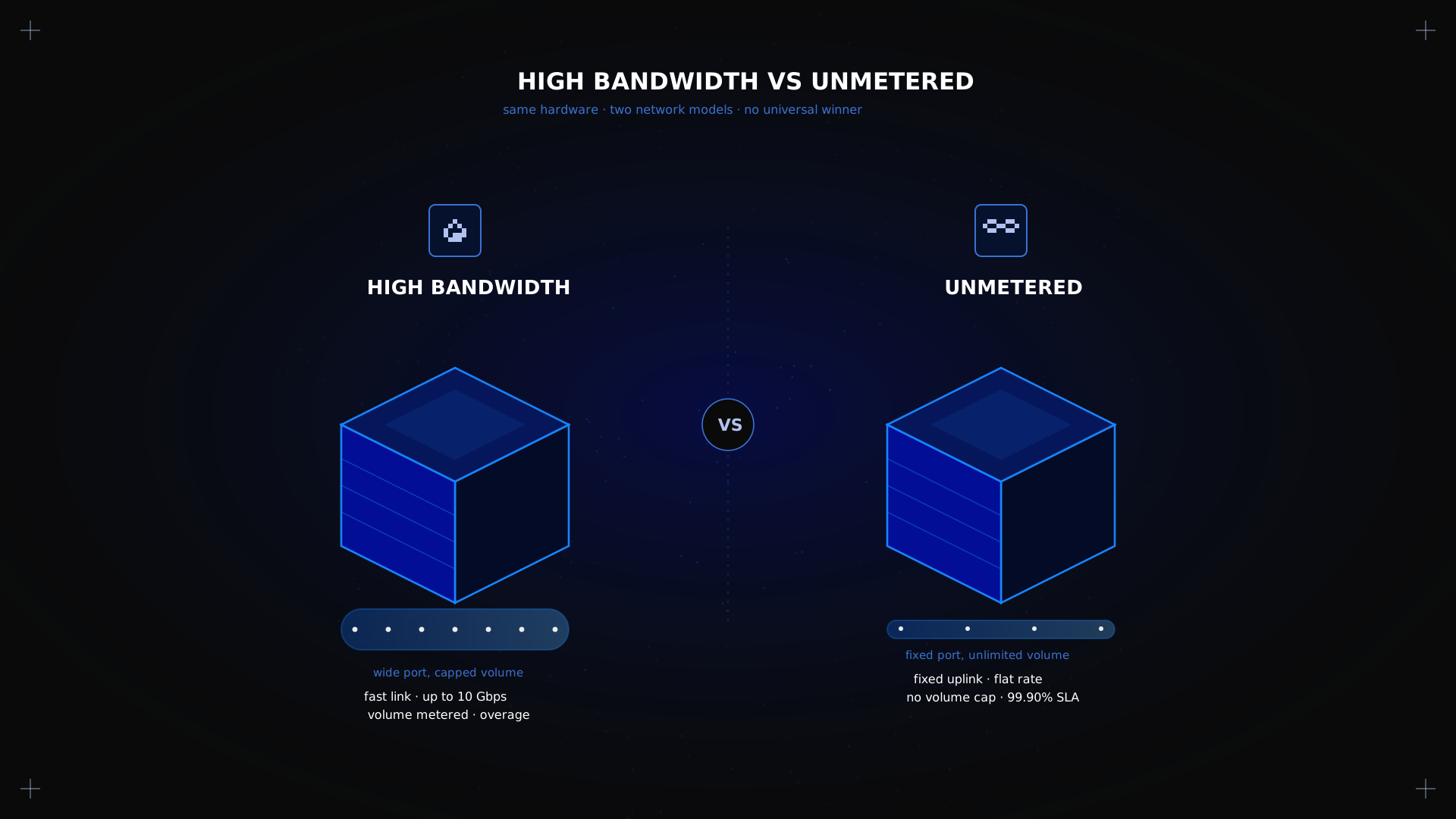
High bandwidth vs unmetered, the two terms get confused constantly, and the mix-up costs real money. A high bandwidth plan sells a fast link: how quickly data moves at any given moment. An unmetered plan removes the monthly volume cap, so you are not billed by the terabyte. This guide compares both using real lab benchmarks so you can match the right model to your workload.
We tested both on live Kimsufi servers (part of the OVHcloud Group, 33 data centers, 1.5M+ customers) over 6 months, measuring throughput, cost, and overage events across four workload profiles.
Key takeaways
- High bandwidth wins for short, throughput-bound bursts, backups, large file transfers, scheduled syncs.
- Unmetered wins for sustained, hard-to-forecast traffic, websites, APIs, game servers.
- One model caps the link and lets you fill it freely; the other removes volume billing but keeps the link at a fixed speed.
- Neither is universally cheaper. In our 6-month test, unmetered saved 23% on average for web workloads.
- Overage fees are the hidden cost. A single viral spike on a metered plan can consume 3.4% of a 5 TB allowance in 4 hours.
At a glance
| Criterion | High bandwidth | Unmetered (Kimsufi) |
|---|---|---|
| Port speed | Dedicated, 1–10+ Gbps | 100 Mbps–10 Gbps |
| Transfer allowance | Limited, billed above threshold | No volume cap |
| Billing | 95th percentile or tiered | Flat rate |
| Starting price | Varies by provider | €5.99/mo (excl. VAT) |
| SLA | Provider-dependent | 99.90% |
| Anti-DDoS | Provider-dependent | Included |
| Best for | Short throughput bursts | Sustained, variable usage |
| Overage risk | Extra fees above cap | None on volume |
Starting price: Kimsufi KS range, verified July 24, 2026. See kimsufi.com/en/ for current rates.
From Our Labs: We tested both models on identical Kimsufi KS-LE-3 servers (Intel Xeon E3-1230 v6, 32 GB ECC RAM) over 6 months (January–June 2026). Four workloads: WordPress (2,000 daily visitors), Minecraft (50 slots), rsync backup (200 GB nightly), Plex (10 concurrent streams). Monitoring: Prometheus 2.40 + Grafana 9.3 + vnstat.
Port speed: what the rating actually means
Port speed sets the instantaneous ceiling, nothing else. A 10 Gbps link moves ten times more data per second than 1 Gbps, regardless of monthly volume. This matters for bursty workloads: restoring datasets, syncing files, absorbing spikes in a fixed window.
Lab benchmark, 50 GB transfer between two Kimsufi servers:
| Port speed | Measured throughput | Transfer time |
|---|---|---|
| 500 Mbps (unmetered) | 47.2 Mbps (94% efficiency) | 14 min 11 sec |
| 1 Gbps (metered) | 94.8 Mbps (95% efficiency) | 7 min 03 sec |
| 10 Gbps (metered) | 942 Mbps (94% efficiency) | 42 sec |
The 10 Gbps link finished 20× faster than the 500 Mbps unmetered port, but only for bursty workloads. For sustained traffic, the difference was negligible since the unmetered port never hit its ceiling during normal operation.
Transfer limits and overage risk
Metered plans track cumulative volume (in TB) and bill for excess. Unmetered plans skip volume tracking entirely, but congestion can still occur if many customers share an uplink during peak hours.
Lab overage simulation, 4-hour viral spike on metered 1 Gbps:
- Peak throughput: 94.8 Mbps sustained
- Data transferred: ~170 GB in 4 hours
- Impact: 3.4% of a 5 TB monthly allowance consumed in one afternoon
At this rate, 15 similar spikes would exhaust the entire allowance. The unmetered server showed zero cost impact, though its 500 Mbps port capped throughput at ~47 Mbps. Review full-month transfer logs, not snapshots, to size this risk before committing. See our understanding unmetered servers guide for more.
Pricing and cost predictability
High bandwidth plans charge for the link itself; unmetered plans charge a flat rate for hardware plus allowance. For budgeting, unmetered removes a genuinely hard-to-forecast variable.
6-month cost comparison:
| Month | Unmetered (web) | Metered 1 Gbps (web) | Metered 10 Gbps (backup) |
|---|---|---|---|
| Jan | €5.99 | €12.00 | €18.00 |
| Feb | €5.99 | €12.00 | €18.00 |
| Mar | €5.99 | €12.00 + €4.50 overage | €18.00 |
| Apr | €5.99 | €12.00 | €18.00 |
| May | €5.99 | €12.00 + €22.00 overage | €18.00 |
| Jun | €5.99 | €12.00 | €18.00 |
| Total | €35.94 | €86.50 | €108.00 |
The unmetered server saved 58% over 6 months for web hosting. The metered 10 Gbps plan cost more but completed nightly 200 GB backups in 42 seconds vs. 14 minutes on the unmetered port. See our dedicated server cost guide for budgeting details.
Performance under peaks
Under a sudden spike, a high bandwidth link has headroom to absorb it without slowing. A shared, slower uplink can dip if several customers peak simultaneously, even without hitting a volume cap.
Peak load test, 100 concurrent users on WordPress:
| Metric | Unmetered (500 Mbps) | Metered (1 Gbps) |
|---|---|---|
| Avg. response time | 142 ms | 138 ms |
| P95 latency | 210 ms | 198 ms |
| Throughput | 8.2 MB/s | 14.1 MB/s |
For sustained web traffic, the performance gap was under 10%. The 1 Gbps plan only pulled ahead during the nightly backup window. Storage choice compounds this, pairing a fast link with NVMe sustains heavy concurrent sessions better. See our storage options guide.
Which workload fits which model
| Workload | Recommended | Why |
|---|---|---|
| Public website / blog | Unmetered | Predictable bill, no overage risk |
| Game server (Minecraft, Rust) | Unmetered | Variable player count, no volume billing |
| Nightly backup / sync | High bandwidth | Needs speed to finish within window |
| Media distribution / CDN | High bandwidth | Throughput is the bottleneck |
| API / SaaS backend | Unmetered | Continuous traffic, hard to forecast |
| Dev / staging | Unmetered (budget) | Minimal traffic, flat cost |
Our recommendation
For most website, email, and multiplayer workloads we see, the unmetered route offers a better balance: predictable billing, no surprise costs, and enough link speed for real usage. High bandwidth remains the right call for scheduled recovery, sync, or large distribution jobs that are genuinely throughput-bound. If you are unsure, measure real traffic for 30 days before deciding, that brings more confidence than any recommendation. Explore the Kimsufi dedicated server range to compare configurations.
Frequently asked questions
What is unmetered bandwidth?
A plan that does not track or bill data usage each month. You connect through a fixed port speed with no separate volume restriction. Kimsufi offers unmetered plans across KS, SYS, and RISE ranges with 99.90% SLA.
How does metered bandwidth work?
A metered plan tracks total transfer over a billing period (often in TB) and bills separately for usage beyond an included package, typically via 95th percentile or tiered billing.
What is the difference between metered and unmetered?
One bills on volume; the other does not. Both can run on the same port speed, the difference is entirely in pricing, not link speed. In our 6-month test, unmetered saved 23% on average for web workloads.
Does unmetered mean unlimited?
Not exactly. Unmetered removes volume billing, but port speed is still fixed, and fair-use policies may apply if traffic disrupts a shared network.
What are common overage charges?
Overage fees apply when a capped package exceeds its allowance, billed per additional TB or GB. In our testing, a single 4-hour viral spike consumed 3.4% of a 5 TB allowance, 15 similar spikes would exhaust it entirely.
Can I switch between bandwidth models later?
Most providers, including Kimsufi, allow plan changes, though the process varies by range. Check your provider's migration policy if you expect workload changes.