























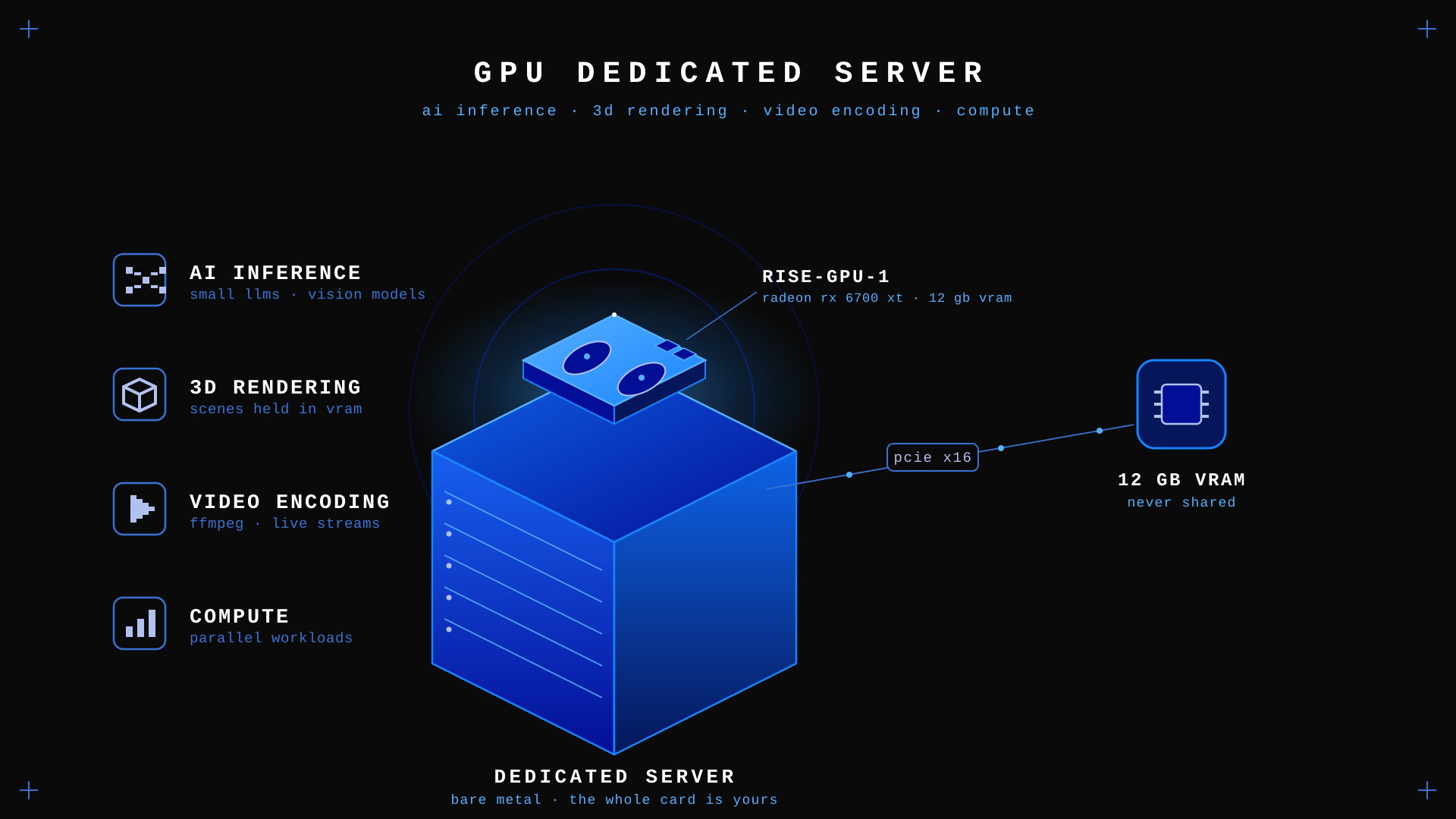
RISE-GPU-1 is the GPU dedicated server from Kimsufi's RISE range: a physical server equipped with an AMD Radeon RX 6700 XT graphics card featuring 12 GB of video memory, offered at €129.99 excl. tax per month. Built for workloads that need a graphics processor all to themselves (inference of small AI models, machine learning, 3D rendering, video encoding, scientific computing), this GPU server makes compute power accessible without the financial commitment of a full HPC infrastructure. In this guide: the complete spec sheet of the RISE-GPU-1, the concrete use cases enabled by its GPU, the difference from a shared GPU, and what to check before renting.
Key takeaways
- RISE-GPU-1 is a dedicated GPU server: AMD Ryzen 7 5800X processor (8 cores / 16 threads), 1× Radeon RX 6700 XT (12 GB video memory), 64 GB DDR4 ECC, 2×960 GB SSD NVMe in soft RAID, 1 Gbit/s unmetered, guaranteed bandwidth, starting at €129.99 excl. tax/month.
- The GPU is entirely reserved for your use: no sharing of the card, unlike cloud instances where the resource is split between multiple tenants.
- The workloads this configuration is suited for: inference of small AI models (SMOL-type families), machine learning, deep learning, 3D rendering, video encoding, scientific computing and light high-performance computing.
- The server is hosted in France, in OVHcloud datacentres in Gravelines (GRA) and Roubaix (RBX); real-time availability is shown on the RISE-GPU-1 product page.
- Before renting, check the compatibility of your software and frameworks with an AMD Radeon GPU: it is the first requirement to validate for an AI or imaging project.
What is a GPU dedicated server?
A GPU server is a physical server that includes, in addition to the central processor (CPU), at least one graphics processor (GPU) for your exclusive use. The graphics processor is not just a display adapter: it is a massively concurrent compute unit, capable of handling thousands of simple operations simultaneously where a CPU excels at complex sequential tasks. This architecture makes the GPU server the natural tool for artificial intelligence, machine learning, 3D rendering, video encoding and part of scientific computing.
The word "dedicated" has two meanings here. First, the server is dedicated: the entire physical server is yours for the duration of the rental, with full root access: this is the principle of dedicated hosting, which we cover in our guide on dedicated servers. Second, the GPU is reserved: the card is neither virtualised nor split between multiple clients. Every compute core, every byte of the 12 GB of graphics memory serves only your workloads.
This is the key difference from "shared" GPU offerings found on virtualised cloud platforms: on a cloud instance, the physical processor is often partitioned between several users, which can introduce performance variability, latency spikes and graphics memory limits. On a GPU server like the RISE-GPU-1, the full resource of the card is yours, and the system has no virtualisation layer between your software and the hardware. To go deeper into this hosting model comparison, our article on dedicated server vs cloud reviews the advantages and limitations of each approach.
RISE-GPU-1: the complete spec sheet
The RISE-GPU-1 belongs to generation II of the RISE range, Kimsufi's performance-to-price-oriented line. Here is the configuration as marketed on the product page:
| Component | Specification |
|---|---|
| Processor (CPU) | AMD Ryzen 7 5800X, 8 cores / 16 threads, 3.8 GHz (turbo 4.7 GHz) |
| Graphics processor (GPU) | 1× AMD Radeon RX 6700 XT, 12 GB video memory |
| RAM | 64 GB DDR4 ECC |
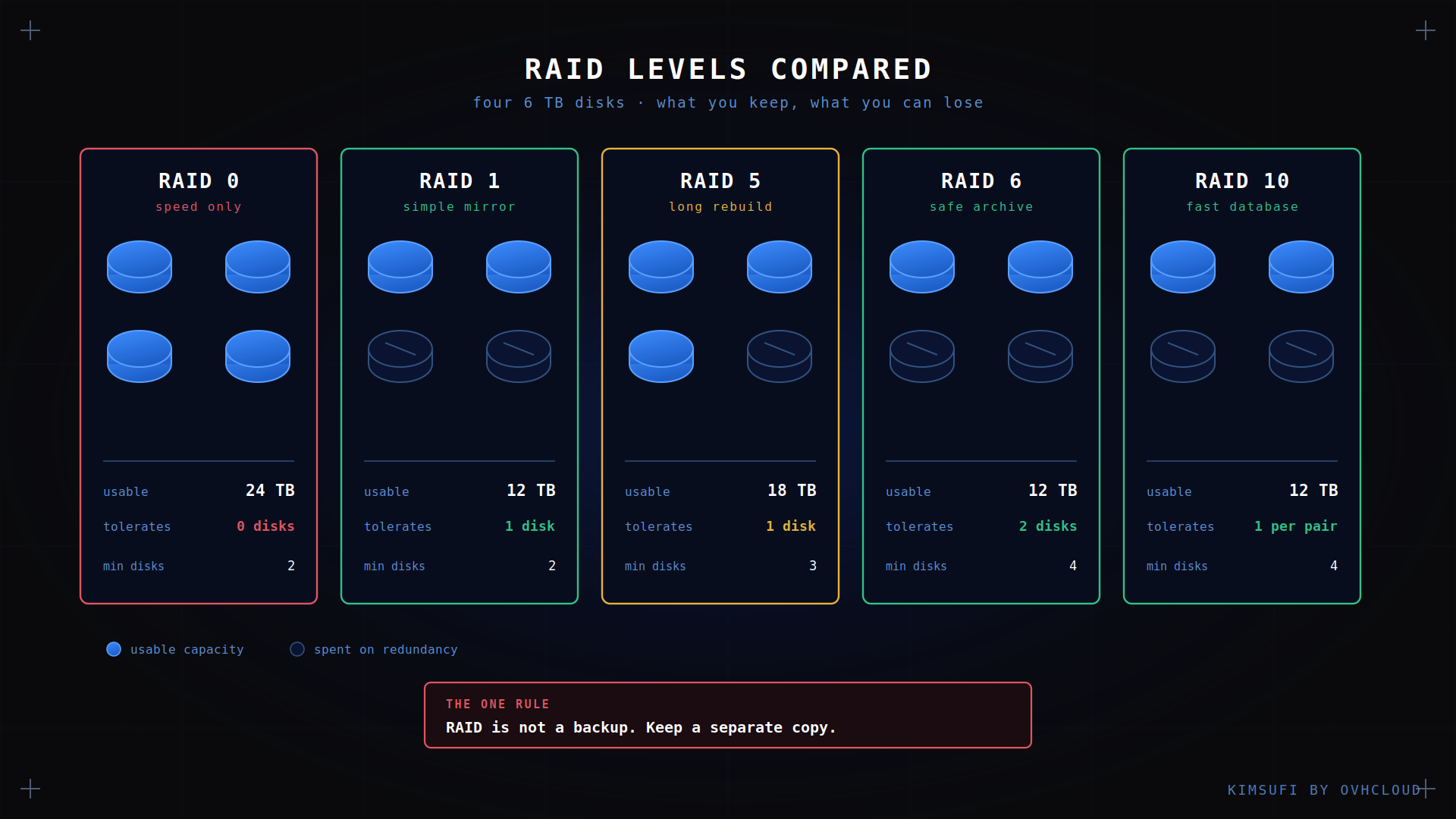
| Storage | 2×960 GB SSD NVMe (soft RAID) |
| Bandwidth | 1 Gbit/s (unmetered, guaranteed) |
| Datacentres | Gravelines (GRA) and Roubaix (RBX), France |
| Price | €129.99 excl. tax/month (€155.99 incl. tax) |
| Setup fee | €129.99 (one-time charge) |
The CPU: an 8-core Ryzen 7 5800X
The AMD Ryzen 7 5800X processor brings 8 physical cores and 16 threads, with a base frequency of 3.8 GHz and a turbo of 4.7 GHz. In a GPU server, the CPU has two roles: preparing and feeding data to the GPU, and running everything that is not GPU-parallelisable: operating system, database, application server, preprocessing. Eight highly-clocked cores form a comfortable base to keep the GPU fed without bottlenecking, whether your workload is an inference service, an imaging pipeline or a development server. Each core can handle a separate task stream, so the CPU can service multiple requests while the GPU handles the heavy compute. The core count matters: too few cores and the GPU starves; eight cores with 16 threads give enough headroom for most single-card setups.
The GPU: the Radeon RX 6700 XT and its 12 GB
The centrepiece of this GPU server is the AMD Radeon RX 6700 XT card, equipped with 12 GB of video memory. Twelve gigabytes of VRAM is the capacity that determines the size of networks and scenes you can load directly onto the card. For inference of small AI models, light fine-tuning, 3D rendering or encoding, this amount of video memory places the RISE-GPU-1 in an accessible category of the GPU server market, far from the multi-card configurations of high-end HPC infrastructures, and at a proportional price. The card's compute cores handle the parallel heavy lifting, while the CPU cores manage data flow and system tasks.
64 GB of DDR4 ECC: reliability on the memory side
The RAM of this GPU server is ECC type (error-correcting code), a professional hardware feature that protects your long-running computations against silent memory errors. 64 GB of RAM leaves room to load datasets, orchestrate containers or run a complete development environment on the server alongside the card. ECC is a hard requirement for any workload where a single flipped bit can corrupt hours of compute: a real concern for model training, scientific computing and rendering jobs.
2×960 GB of SSD NVMe in soft RAID
On this GPU server, storage relies on two 960 GB NVMe SSDs in software RAID: NVMe ensures fast reads and writes, useful for loading model weights from disk to video memory or for data pipelines. The NVMe drives reduce the I/O latency that would otherwise bottleneck the GPU during model loading.
Concrete use cases: what does the RISE-GPU-1's GPU enable?
A GPU server serves a simple idea first: running on your own hardware the concurrent workloads that saturate a CPU, by harnessing the GPU's compute resource rather than the central processor's. Here are the concrete use cases for which the RISE-GPU-1 is sized.
AI and machine learning: inference of small models
The most common demand today for a GPU server is inference of AI models: running a trained model to answer queries, without depending on an external API or a cloud provider. Small language and vision models (a few hundred million to a few billion parameters, such as SMOL-type families or compact quantised models) fit within the 12 GB of video memory of the Radeon RX 6700 XT and form the core target of this server. Hosting inference yourself on your own GPU server lets you keep control of your data, master your cost per request and serve your users from France. It is also an excellent environment for experimentation: deploy a model, measure it, replace it, without usage-based billing. As a provider of bare metal servers, Kimsufi gives you the hardware resource to run these workloads on your own terms.
Deep learning: training and light fine-tuning
For deep learning, the GPU accelerates two steps: training itself and fine-tuning (adjusting an existing model on your data). Training a large model on a single 12 GB card is not what the RISE-GPU-1 is for; however, fine-tuning of small networks, training of modestly sized models and all your research and prototyping work run on this hardware at a fixed monthly price: a real advantage over hourly on-demand billing as soon as the server runs several hours a day. One requirement to check before any project: your framework and compute libraries must support the AMD GPU in this configuration.
3D rendering and CGI
3D rendering is the historical vocation of GPU compute: imaging engines, architecture scenes, animation or product design benefit directly from the GPU's concurrent power. A GPU server lets you offload render farms to an always-on, remotely accessible server that ties up neither your workstation nor your connection. For studios and freelancers, it is a permanent image production capacity at a known cost, on stable hardware. The 8 CPU cores can manage scene setup and asset loading while the GPU cores crunch the pixels.
Video encoding and streaming
Encoding and transcoding are concurrent workloads that the GPU handles far better than a classic processor: on-demand content preparation, multi-format derivation, media pipelines. If your application produces or transforms media streams, a GPU server drastically reduces encoding times compared to a server without a GPU, and the low latency of local storage keeps the pipeline moving.
Scientific computing (light HPC)
Numerical modelling, scientific computing, batch processing: part of HPC workloads lends itself to GPU compute. The RISE-GPU-1 covers the "light HPC" segment: that of labs, engineering firms and data science teams who need a permanent GPU compute server and an application server, without renting a full high-performance infrastructure. For intensive computing needs beyond a single card, OVHcloud offers specialised ranges, such as the GPU dedicated servers in its bare metal line, sized for multiple graphics cards.
Dedicated GPU or shared GPU: what is the difference?
This is the central question when choosing. On virtualised cloud platforms, a shared GPU is a physical processor split between multiple clients through virtualisation: you rent a fraction of the card, with a portion of its video memory. The advantage is flexibility: you turn it on and off on demand. The limitations are performance variability, latency from the virtualisation layer, the memory ceiling and usage-based cost, which climbs quickly for a permanent workload. You also depend on the cloud provider for resource allocation.
On a GPU server like the RISE-GPU-1, the situation reverses: the entire GPU resource is reserved for you, performance is stable since no other workload competes for the resource, and the cost is a fixed monthly fee rather than consumption-based pricing. For a continuous workload (a production inference application, an imaging pipeline, an experimentation server that runs every day), the dedicated approach is generally more predictable and more economical. Our comparison of dedicated server vs VPS explains the same logic applied to servers without a GPU: sharing lowers the entry price, but a dedicated server wins as soon as the workload is sustained.
Pricing and commitments for the RISE-GPU-1
The RISE-GPU-1 GPU server is listed at €129.99 excl. tax per month, or €155.99 incl. tax, plus a setup fee of €129.99 charged once at provisioning. The offer is available in France in the Gravelines and Roubaix datacentres, Kimsufi is an OVHcloud brand, and the server is delivered on its infrastructure.
Regarding commitments, the commercial sheet of the offer provides formulas with a prior commitment (upfront) of 12 or 24 months, as well as, for direct sale, durations of 6 to 60 months or a monthly formula with no commitment: the exact conditions and associated discounts are displayed at the time of ordering on the product page. Availability varies by datacentre and timing; once the system is delivered, the server's resource remains identical for the entire rental period, guaranteeing stable performance. Stock is shown in real time on the RISE-GPU-1 configuration page, which is the starting point for ordering.
As a reference point within the Kimsufi range, a server without a GPU in the RISE line starts at €64.99 excl. tax/month; the premium of the RISE-GPU-1 corresponds to the dedicated GPU and its 12 GB of video memory. To map out your overall budget, our budget dedicated servers page lists the price tiers of the KS, SYS and RISE ranges.
Windows and available licences
While most AI and imaging workloads run on Linux, the RISE-GPU-1 can also be delivered with a Windows system: Windows Server licences (from 2016 to 2025, Standard and Datacenter editions) and SQL Server (2017 and 2019, Web and Standard editions) are offered as options at checkout. The licence fee is then added to the server's monthly price. Under Linux, installing your distribution and configuring the system is done freely with root access; our guide on configuring a Linux server covers the first steps. The initial setup of the GPU drivers and your compute framework is the key requirement to get right. Once the system is configured and the GPU resource is properly allocated, the server runs your workloads without any hypervisor overhead.
Conclusion
The RISE-GPU-1 puts a dedicated GPU server at €129.99 excl. tax/month in the hands of teams who want to host their accelerated workloads themselves: inference of small AI models, machine learning, 3D rendering, encoding, scientific computing and light HPC. The AMD Ryzen 7 5800X processor with its 8 cores, the 12 GB of video memory on the Radeon RX 6700 XT, the 64 GB of DDR4 ECC and the 2×960 GB of NVMe form a coherent configuration, hosted in France at Gravelines or Roubaix, billed at a flat rate. Before you configure the system, two requirements to check: the compatibility of your software with the AMD GPU, and the availability shown on the product page. Everything else is configured in a few clicks (system, options, licences, datacentre) from the RISE-GPU-1 page.
FAQ: everything about dedicated GPU servers
What is a dedicated server?
A dedicated server is a physical server rented in full by a single client: all resources (CPU cores, RAM, storage, GPU if applicable) are reserved for you, with full root access. The complete definition and the differences with shared hosting are in our article on what is a dedicated server.
What is a GPU compute server?
It is a GPU server equipped with one or more compute accelerators, providing the power needed for concurrent applications: artificial intelligence, machine learning, 3D rendering, encoding, scientific computing. The GPU processes thousands of operations concurrently, making these workloads much faster than on a CPU alone.
Which GPU server to choose for AI?
Three criteria: the card's memory (it determines the size of the neural network model you can load: 12 GB on the RISE-GPU-1), the compatibility of your frameworks with the GPU, and the billing model (flat monthly fee of a dedicated server versus on-demand hourly billing from a cloud provider). For inference of small models, light fine-tuning and experimentation, a single-card GPU server like the RISE-GPU-1 is the simplest entry point; for massive training, look at OVHcloud's higher ranges equipped with multiple cards, for example the Scale-GPU-3. A dedicated GPU server gives you predictable performance that a cloud GPU instance cannot match for sustained workloads.
Where to rent a GPU server from OVHcloud?
At Kimsufi, this GPU server can be ordered directly from its product page: choose the datacentre, the system and the options, then validate the configuration. OVHcloud also offers GPU servers in its main bare metal range, including the Scale-GPU-1 and Scale-GPU-2 for heavier needs, as well as a page dedicated to the best cloud GPU for your use case.
What is the difference between a dedicated GPU and a shared GPU?
A shared GPU is a virtualised fraction of a card, rented on demand in the cloud: flexible but variable, with a memory ceiling and added latency. A dedicated GPU is an entire physical card reserved for your server: stable performance, all the memory for you, flat-fee cost. For a workload that runs continuously, a dedicated GPU server is generally the best choice.
Do I really need a GPU server?
If your workload leverages GPU compute (AI, imaging, video, scientific computing) and runs regularly, yes: a GPU server quickly amortises its monthly fee against consumption-based billing. For a website, a database or a usage without GPU, a classic server remains more relevant: our guide do I need a dedicated server helps you decide.