








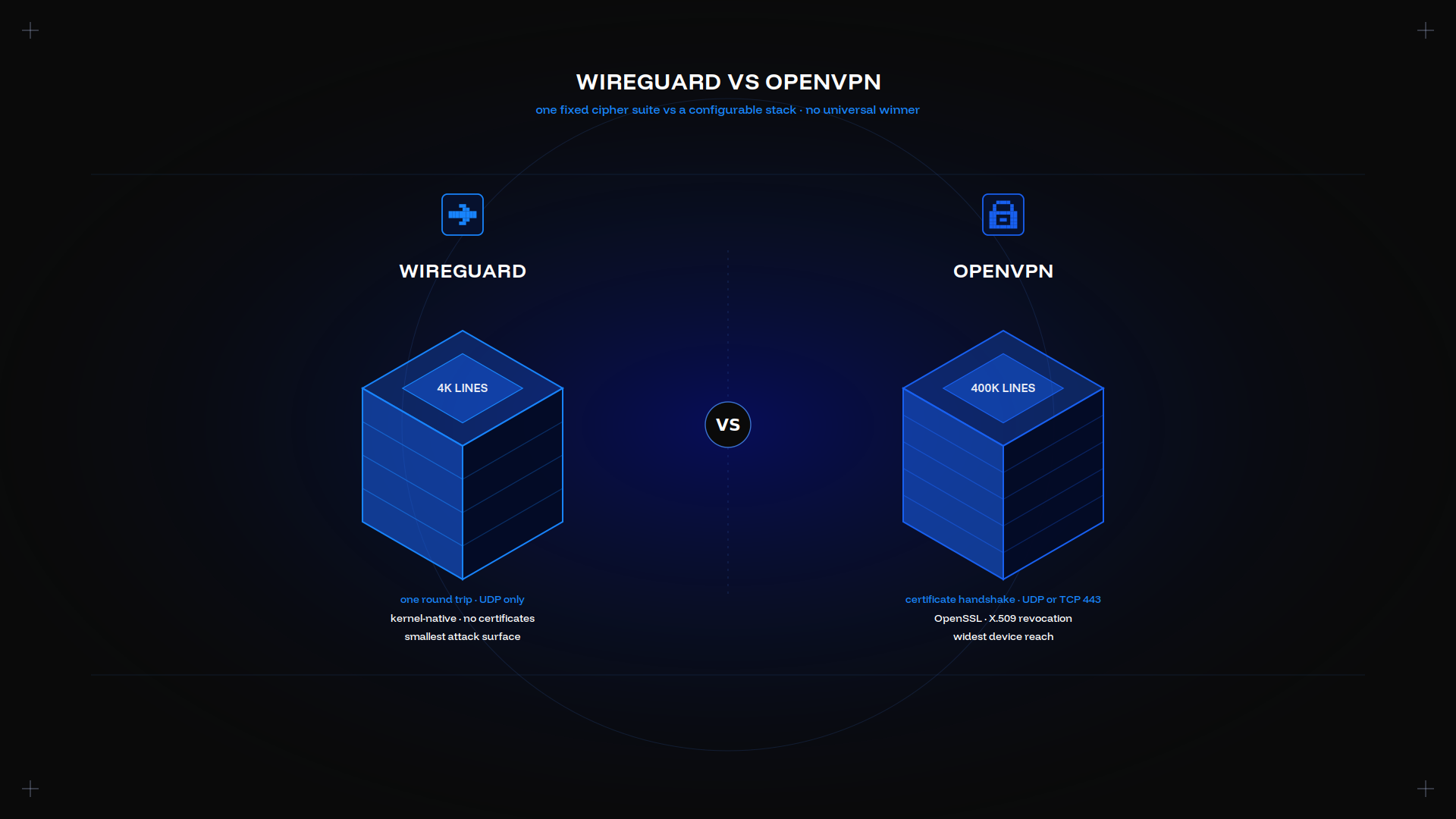
WireGuard and OpenVPN both build a secure tunnel between two machines, but they take opposite approaches to cryptography, configuration, and code size. This guide covers speed, security, setup, and compatibility, so you can pick the protocol your deployment needs.
Key takeaways
- The WireGuard source is roughly 4,000 lines against OpenVPN's 400,000. That gap explains most of what follows.
- The throughput argument changed in 2026: OpenVPN 2.7 with the DCO kernel module closes, and sometimes reverses, the gap.
- WireGuard has one fixed cipher suite. OpenVPN offers a configurable option through OpenSSL: flexibility and exposure at once.
- Mullvad dropped OpenVPN support entirely on 15 January 2026. NordVPN and Proton VPN still support both.
- OpenVPN remains the reliable choice for the TCP 443 protocol path, layer 2 mode, and legacy clients. Everything else favours WireGuard.
What is WireGuard? Architecture and core features
WireGuard is a VPN protocol built into Linux since kernel 5.6. WireGuard is modern by design, written by Jason Donenfeld, merged in 2020, and small enough to audit in an afternoon.
One cipher suite, no negotiation. ChaCha20-Poly1305 for encryption, Curve25519 for key exchange, BLAKE2s for hashing. No cipher menu means no downgrade attack against a badly chosen option.
Peers, not clients and servers. Every endpoint is a peer with a public key and allowed IP addresses. The protocol makes no distinction between the two ends of a connection, so remote access and a site-to-site link that connects out look identical.
UDP only, one port. WireGuard listens on a single UDP socket and answers nothing unless a packet carries a valid key. To a scanner the host looks closed, because WireGuard ignores it entirely.
Most commercial VPNs now default to WireGuard, and newer VPNs ship nothing else. WireGuard underpins NordVPN's NordLynx, which wraps it in double NAT so no static internal IP is stored per user. Not all still support OpenVPN.
What is OpenVPN? Architecture and core features
OpenVPN is a VPN protocol first released in 2001, built on certificate exchange and the OpenSSL library. It runs in user space, and most router firmware still supports OpenVPN out of the box. Commercial VPN services have offered it for two decades.
Certificates and X.509. The OpenVPN protocol establishes a session with the same certificate machinery as HTTPS, bringing revocation, per-user credentials, and PKI integration. WireGuard offers none of it.
UDP or TCP. OpenVPN offers either as a transport option. On TCP port 443 it is hard to tell from ordinary HTTPS, which is why it survives restrictive networks where no other service gets through.
TUN or TAP. TUN handles the IP route. TAP creates a layer 2 bridge, so broadcast and non-IP protocols cross it. WireGuard has nothing equivalent.
Version 2.7, released February 2026, added multi-socket servers, 1.3 support through mbedTLS, and the upstream ovpn module. That last item matters most.
Performance comparison: speed, latency and throughput
For years the summary was simple: WireGuard is faster. It runs inside the kernel while OpenVPN copies data out to user space, and it outperforms OpenVPN on almost every benchmark. Data Channel Offload changed that.
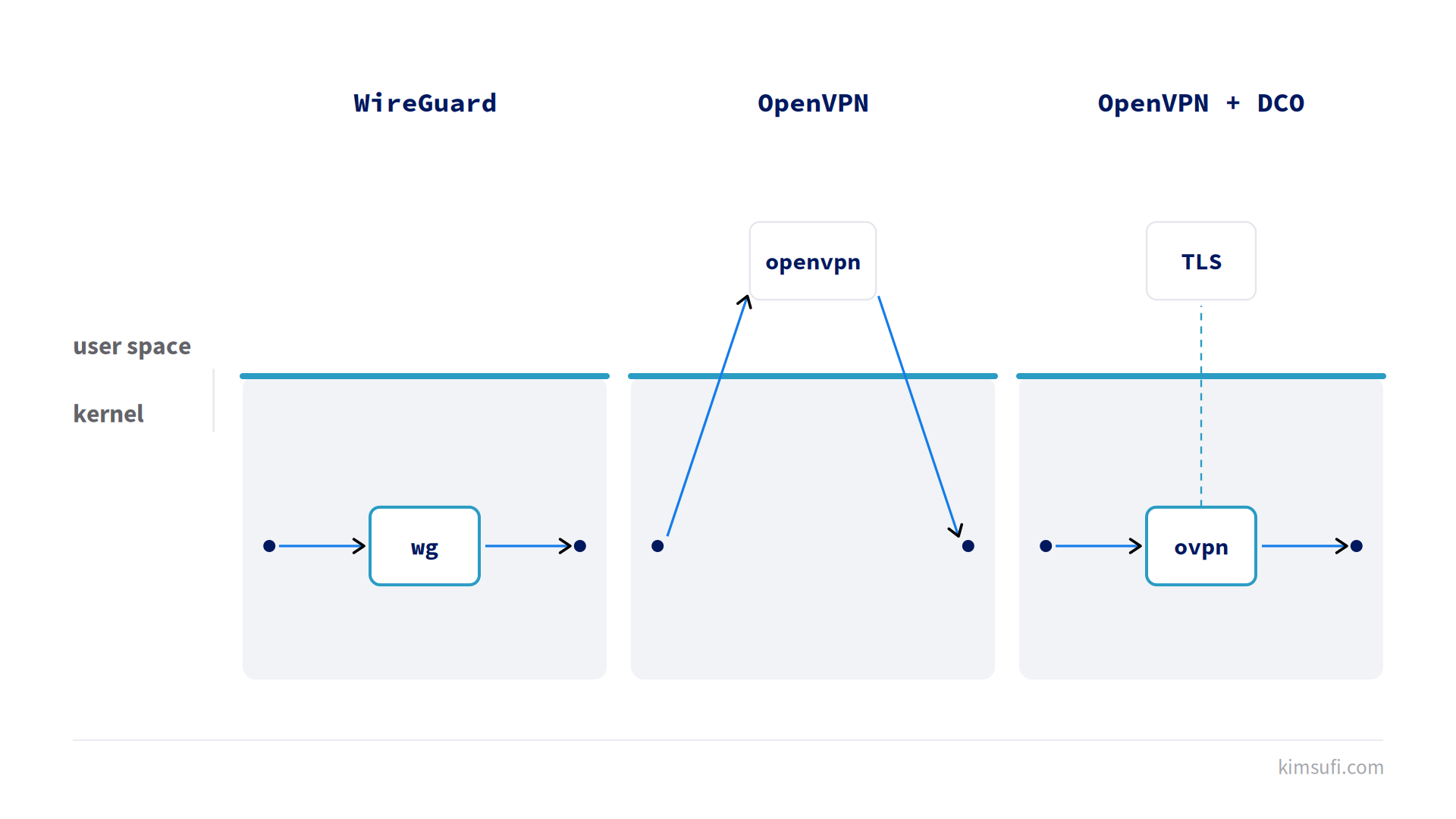
DCO moves the OpenVPN data channel down beside it, leaving the certificate control channel in user space. The ovpn module reached Linux 6.16 and needs OpenVPN 2.7 or later.
The numbers are now close enough to argue about, and one is faster: OpenVPN with DCO, on the vendor's own numbers. Its DCO guide cites a router at 700 Mbps against 600 for WireGuard, and an IPVanish rollout at up to 196% higher download throughput.
Read those with the source in mind: they come from the OpenVPN project and a hardware vendor. What is not disputed is that DCO removes the context-switching penalty behind the old verdict.
Two limits ensure WireGuard stays ahead in practice. DCO is UDP only and does not yet handle OpenVPN's internal routing, so multi-site deployments cannot use it. Most installed servers still run without it.
Latency is separate. WireGuard's handshake completes in one round trip against several for a certificate exchange, so the connection resumes almost instantly after a network change. Where the link is the constraint, our guide to high bandwidth and unmetered servers matters more.
Winner: OpenVPN with DCO on raw throughput, narrowly. On latency it is still WireGuard. WireGuard also wins on any server without DCO.
Security and encryption: cipher suites, handshake and attack surface
Both are secure when configured correctly, and both use strong modern cryptographic primitives in their current implementations. They disagree about who chooses them.
WireGuard fixes the choices. One suite, no negotiation, no fallback. You cannot weaken it by accident, and less code means a smaller attack surface.
OpenVPN makes them configurable. Cipher, key size, and protocol version are yours to set through the OpenSSL library. Strict environments treat that as a strict cryptographic requirement; everyone else, as a liability.
The exchange works differently. WireGuard pairs Curve25519 keys with no certificates, so there is no authority to run. OpenVPN inherits both the revocation machinery and the historical exposure of certificate implementations.
WireGuard has one known privacy trade-off: the server keeps a peer table mapping public keys to the last seen IP. NordVPN and Proton VPN work around it with a shared internal address and NAT.
Post-quantum cryptography reached both sides without forking either protocol, which says something about how robust both designs are. Both designs proved robust enough to take it: two providers inject ML-KEM through WireGuard's pre-shared key slot, and certificate-based protocols use the TLS 1.3 hybrid exchange.
Winner: WireGuard. WireGuard's lightweight build, modern cryptographic suite, and small surface remove a whole class of misconfiguration. Both cryptographic implementations are audited; only one is small enough to read.
Ease of setup and configuration on different platforms
A working WireGuard configuration is fifteen lines: a private key, a listen address, a peer block per client. wg-quick up wg0 brings it online.
OpenVPN needs a certificate authority: a CA, a server certificate, a key per client, and Diffie-Hellman parameters before the service starts. Easy-RSA streamlines it, but the concept count stays higher.
Both ship official apps for Windows, macOS, Linux, iOS, and Android, so neither platform list decides it. The WireGuard app is leaner, and its mobile app is simpler to hand to a non-technical user.
Either one on your own dedicated server needs a public IP, an open port, and forwarding enabled. Getting those right ensures the first connection comes up cleanly. Our firewall configuration guide covers the rules.
Winner: WireGuard. WireGuard drops the certificate step entirely, the part most self-managed OpenVPN deployments get wrong.
Compatibility with devices, routers and firewalls
This is where OpenVPN earns its keep: two decades of adoption mean it runs on hardware that never heard of WireGuard.
Routers and appliances. A wide range of consumer and business routers ship an OpenVPN client. WireGuard support is widespread but not universal, and old firmware will never gain it.
Restrictive networks. WireGuard uses UDP, and any network allowing only TCP on 80 and 443 drops it. OpenVPN on 443 blends into ordinary internet traffic, the reliable way of bypassing that kind of internet filtering. Getting WireGuard through needs a proxy or obfuscation wrapper.
NAT traversal. Both cope. WireGuard needs a keepalive on the peer behind NAT to stay connected, one line. OpenVPN handles it unaided.
Legacy systems. OpenVPN builds for systems WireGuard never targeted, a real advantage.
Winner: OpenVPN. OpenVPN reaches a wide range of devices and networks. That versatility is OpenVPN's remaining moat, and the cryptographic agility behind it is real versatility, not marketing.
Resource usage: CPU, memory and battery impact
The lean codebase shows up as a smaller footprint, and the lean design keeps operation simple. ChaCha20 is efficient on processors without AES acceleration, and stays efficient on the cheap routers that describes.
On mobile the difference is battery. WireGuard is stateless between packets and sends nothing when idle, so a phone can sleep. Compared to OpenVPN, which holds a session and pings to keep it alive, that is a measurable gain.
Memory shows the same gap: OpenVPN needs megabytes per connection, a WireGuard interface a few hundred kilobytes. Across hundreds of live connections the lightweight design earns its keep.
Winner: the lean design, so WireGuard. WireGuard wins every metric in this section.
Use-case scenarios: home lab, business VPN, mobile users
Home lab. WireGuard, with almost no argument. You control both ends and the configuration fits on one screen. Reaching a virtualization server from a laptop takes ten minutes.
Business VPN. Corporate VPNs are where OpenVPN still competes. Per-user certificates, revocation when someone leaves, and directory integration are things WireGuard does not do natively. Where compliance names a cipher policy, that configurable suite is an advantage.
Mobile users. WireGuard, for battery and for remote roaming. Moving from Wi-Fi to cellular rebuilds the connection in one round trip, which ensures the session survives.
Latency-sensitive traffic. WireGuard's shorter setup and lower overhead suit anything real-time, including a game server.
Regulated workloads. Where the tunnel is one control among many, look at the hardware underneath. Our confidential computing server page covers protection for data in use, not only in transit.
Winner: it depends on the use case, the honest option here.
Future outlook: will WireGuard replace OpenVPN?
Partly, and it already has. WireGuard is now the default almost everywhere. Mullvad shut down its last OpenVPN servers on 15 January 2026, having announced the removal a year earlier: WireGuard now matches OpenVPN's obfuscation with better performance and stronger security. Dropping OpenVPN support was framed as a simplification.
Others went the other way. NordVPN keeps OpenVPN UDP and TCP for manual setup alongside NordLynx, and Proton VPN offers WireGuard plus OpenVPN, IKEv2, and Stealth.
OpenVPN is not standing still. The 2.7 release and the upstream DCO module, covered by Phoronix in February 2026, answer the criticism that mattered most.
The likely outcome is specialisation, not replacement. WireGuard becomes the standard choice for new deployments; OpenVPN remains where TCP camouflage, layer 2 traffic, or certificate-based access control are requirements.
Winner: neither, and that is the point.
How to choose between WireGuard and OpenVPN – decision checklist
WireGuard vs OpenVPN, WireGuard wins by default. Pick it unless a row below is a hard constraint.
| Requirement | Winner |
|---|---|
| Maximum throughput on a current kernel | Either, with DCO enabled |
| Lowest latency and quick reconnection | WireGuard |
| Must cross a TCP-only network | OpenVPN |
| Per-user certificates and revocation | OpenVPN |
| Layer 2 bridging or non-IP traffic | OpenVPN |
| Mobile clients and battery life | WireGuard |
| Legacy routers or old operating systems | OpenVPN |
| Smallest codebase to audit | WireGuard |
| Simplest client to hand to a user | WireGuard |
Stop at the first row that applies; that one protocol choice settles the rest. If none does, WireGuard is the simpler protocol to run and the easier one to keep secure.
Conclusion
The picture is no longer one-sided. The short answer is WireGuard. WireGuard is the better default on almost every axis: less code, less to configure, less to get wrong, lower overhead.
OpenVPN with DCO has closed the performance gap that defined this debate, and it offers capabilities WireGuard never has. That is the real difference: OpenVPN buys reach, WireGuard buys simplicity.
Run whichever fits your constraints, on hardware you control. The Kimsufi range starts at $11.10 USD/month, SYS at $33.20 USD/month, and Rise at $64.00 USD/month, with full root access and unmetered traffic. Compare our budget dedicated servers to size yours.
Frequently asked questions
What are the disadvantages of WireGuard?
No TCP mode, so it fails where UDP is blocked. No native obfuscation, and no certificate-based authentication or revocation. The server keeps a peer table with each peer's last seen IP, a privacy consideration for public VPNs.
Is NordVPN OpenVPN or WireGuard?
Both. The NordVPN default is NordLynx, built on WireGuard with a double NAT layer; OpenVPN UDP and TCP remain for manual setup.
Is WireGuard the fastest VPN?
Usually, though no longer always. With OpenVPN 2.7 and DCO on Linux 6.16 or later, raw throughput is comparable and can be higher. WireGuard still wins on the time it takes to connect.
Is ProtonVPN OpenVPN or WireGuard?
Both, plus IKEv2 and Stealth. Proton VPN also layers its own VPN Accelerator on WireGuard to improve performance over poor internet connections.
Can WireGuard work on older operating systems?
Only where a client exists. WireGuard needs a current Linux build or a user-space port, and nothing exists for genuinely old systems. That is a common reason estates keep OpenVPN.
How does OpenVPN's TLS authentication differ from WireGuard's handshake?
OpenVPN authenticates with X.509 certificates over several round trips. WireGuard exchanges public keys in one, with no certificate authority to run.
Which protocol offers better battery life on mobile devices?
WireGuard, clearly. It sends nothing when idle and needs no session keepalive, so the radio and CPU stay quiet.
Is it possible to run both WireGuard and OpenVPN simultaneously?
Yes, and it is a standard setup. They use separate interfaces, so one server runs WireGuard over UDP and OpenVPN on TCP 443 as the fallback. Many self-managed services keep both, and the OpenVPN protocol handles the awkward networks.
How do firewall and NAT traversal differ between the two protocols?
WireGuard needs one inbound UDP port and a persistent keepalive on peers behind NAT. OpenVPN needs one port and handles NAT unaided. Neither asks anything unusual of the network.