






















A database server stores your application's data in tables or documents and answers its queries. This comparison covers the managed platforms and the self-hosted solutions worth shortlisting in 2026, from PostgreSQL and MariaDB to MongoDB, and how to match one to the scale you need.
Key takeaways
- PostgreSQL 18 is the strongest default for a new application. Its asynchronous I/O gives up to 3× faster storage reads.
- Pick the data model first. A fixed schema of tables points to PostgreSQL, MySQL or MariaDB; a varied structure points to MongoDB.
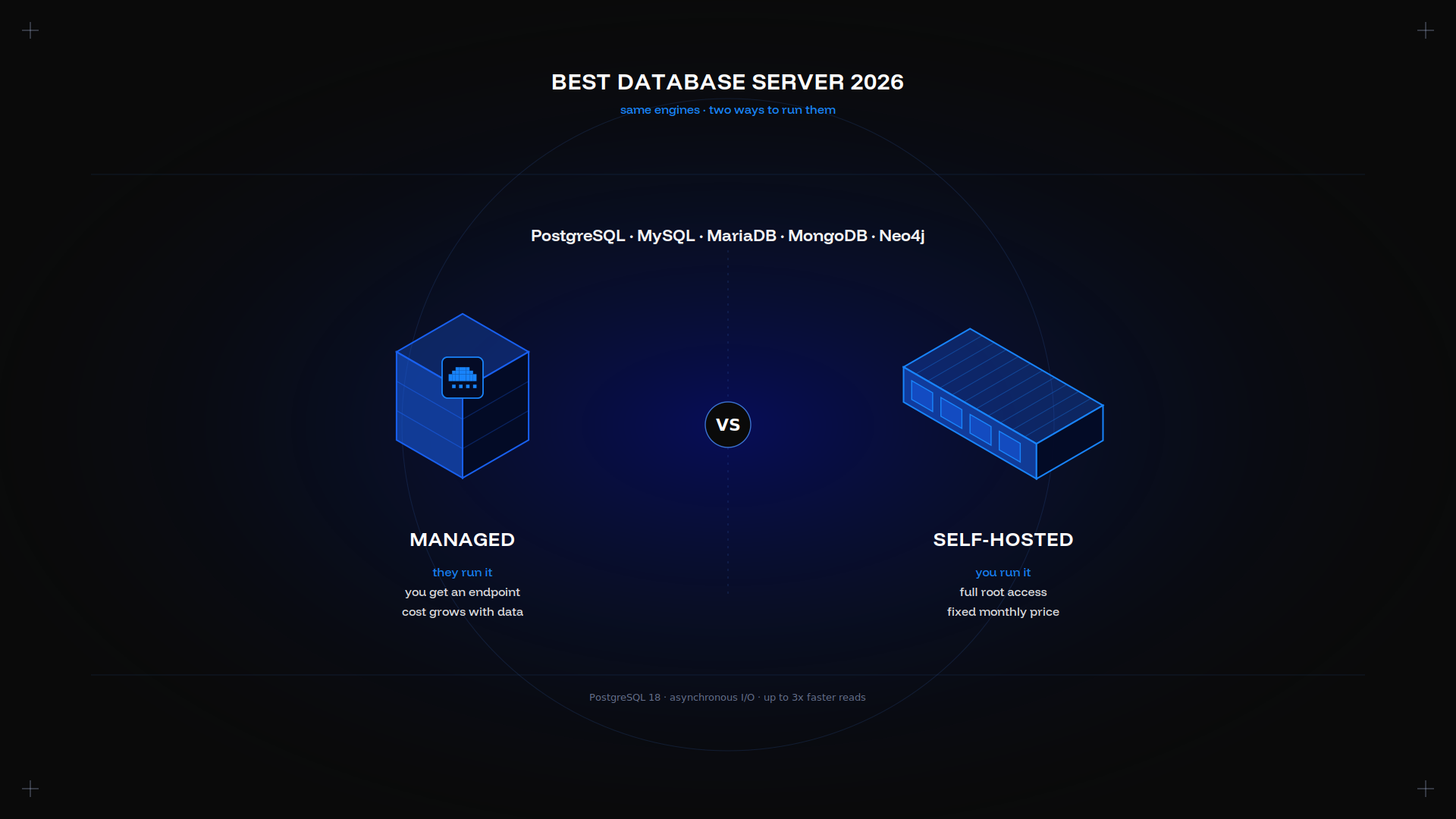
- Managed means you rent the operations and the support. Self-hosted means you own them, and the bill stops scaling with your data.
- Licensing decides more than performance: PostgreSQL is permissive, MySQL is GPL, and distributing it has consequences.
- For one database serving one application, a dedicated server beats every managed tier on price per gigabyte.
Every option below runs the same open source engines. What changes between a managed platform and your own machine is who handles the cluster, the backups and the upgrades, and what the solution costs as you scale.
What is a database server?
Two things wear the name. The software, meaning PostgreSQL, MySQL or MongoDB. And the machine it runs on, with its CPU, memory and storage. Both matter, and most database comparisons only discuss the first.
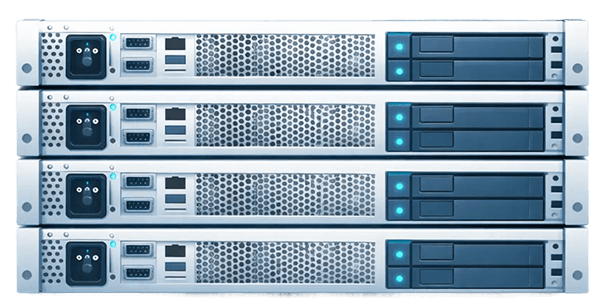
The distinction is practical. A database server answers queries from an application over a connection, holds the data structure on disk in tables or documents, and keeps it consistent while multiple clients write at once. It serves every application that depends on it, so its performance is theirs. Whether that machine is one you rent bare or one a vendor operates for you is a separate decision from which database engine you run.
Relational, document, graph
Three architecture families cover almost every database deployment. A relational database stores rows in tables with a fixed schema and guarantees transactions, which is what most business applications need. A NoSQL document database stores records whose structure can vary between them, which suits an application whose data model is still moving. A NoSQL store scales out across nodes more readily than a relational one. A graph database stores relationships as first-class objects.
The architecture you pick constrains everything downstream: how the database scales, which tools are compatible with it, what performance you can reach, and how hard the migration is if you change your mind. Our dedicated database server page covers the hardware side.
Key criteria for choosing a database server
Six things decide it, roughly in this order.
Data model. Relational for structured data with a fixed schema and transactions. Document for varied structure. Graph for relationships. Pick the model before the product, because it is the one decision a later migration cannot undo cheaply.
Query shape. Transactional work needs low-latency writes and strong consistency. Analytics needs to scan large datasets. An analytical store and an OLTP database are different things, and one database server rarely serves both well.
Scalability path. Vertical scaling means a bigger machine. Horizontal scaling means multiple nodes with replicas or shards to distribute the load. Know which scalability path you need before you are forced into it.
Operational burden. Backups, failover, upgrades, configuration and monitoring. Either you do them or you pay someone. A robust deployment needs all five, whichever database you run.
Licensing. Open source is not one licence, and the differences bite at distribution time. Check it before you commit to a database.
Total price. Not the monthly tier, but the tier plus the storage plus the egress plus your time.
Write these down as a requirement list before you compare database products. Most teams pick a database from familiarity, then discover the requirement they missed, which is usually scalability or a licensing constraint.
Top 5 managed database servers
Managed means the vendor runs the deployment, patches it, and handles failover. You get an endpoint and a bill.
Amazon RDS serves PostgreSQL, MySQL and SQL Server with automated backup, multi-AZ recovery and read replicas. The default choice when you already run on AWS.
Google Cloud SQL serves the same engines with high availability and sub-second maintenance switchover. Strong integration with the rest of the platform.
MongoDB Atlas is the managed document option, with native sharding, configurable consistency and a mature ecosystem. It is the reference for schema-flexible applications.
Azure Database for PostgreSQL matters if your organization is already on Microsoft, with directory integration that saves real work and good compatibility with existing tooling.
Neon and PlanetScale represent the newer serverless alternative: branching, scale-to-zero and per-request billing, aimed at development workflows rather than steady production load. Useful as a development database, less so as a production one.
Each platform handles the same operational set: automated backup, a replica for read traffic, patching, and monitoring. They differ in which engines they serve, how the replica is billed, and what the egress costs when you pull data out. Compare those three before the feature tables.
MongoDB Atlas deserves a closer look, because it is the platform most often shortlisted for document workloads. Atlas runs a replica set by default, so an Atlas deployment is three nodes rather than one, and the tier you pick sets the memory and storage of each node. Atlas handles sharding, backup and failover, and the Atlas free tier is genuinely useful for development. The catch is the same as every managed platform: an Atlas cluster costs several times what the same workload costs on hardware you rent, and the gap widens with your dataset.
The trade. Managed removes the operational burden and adds a multiplier to the cost. That multiplier is worth paying when your team is small and your data is not, and hard to justify in reverse.
Top 5 self-hosted database servers
PostgreSQL is the strongest general-purpose open source database in 2026. Version 18 added an asynchronous I/O subsystem with up to 3× faster storage reads, skip scan lookups on multicolumn indexes, uuidv7() for timestamp-ordered keys, and planner statistics that survive a major upgrade. Its JSON support is good enough that many teams no longer need a separate document database alongside it.
MySQL remains the most widely distributed relational engine, now at 9.7 LTS. Mature replication, an enormous tool ecosystem, and the engine most hosting panels assume. Note that masking and JavaScript stored programs live only in the commercial Enterprise edition.
MariaDB forked from MySQL over Oracle's ownership and has diverged since. Version 12.3 is current, and 11.8 LTS brought native vector search, which removes the need for a separate extension on AI-adjacent workloads. Its MySQL compatibility remains its main selling point.
MongoDB Community gives you the same NoSQL document model on your own hardware, with replica sets for availability and sharding to distribute data across nodes.
Neo4j is the graph option. When your queries are about relationships rather than rows, Neo4j answers in a single traversal what a relational schema needs several joins to reach. It is the narrowest product here and the right one for a specific shape of problem.
All five are open source database servers you can deploy on your own machine. That is the real alternative to a managed tier: the same open source database, the same replica topology, on hardware whose price does not move with your data. For most teams that alternative is the cheaper solution by a wide margin.
Performance and scalability comparison
| Engine | Model | Scaling path | Strong at |
|---|---|---|---|
| PostgreSQL | Relational | Vertical, read replicas | Mixed workloads, complex queries |
| MySQL | Relational | Vertical, replicas | Read-heavy web applications |
| MariaDB | Relational | Vertical, replicas, Galera | Read-heavy, vector search |
| MongoDB | Document | Horizontal scaling, sharding | Varied structure, high write volume |
| Neo4j | Graph | Vertical, causal cluster | Relationship queries |
Two honest caveats. Published performance benchmarks rarely survive contact with your data, so treat any percentage claim as a hypothesis to compare against your own dataset. Database performance is workload-specific. And on a single machine, the storage decides more than the engine: our storage options guide covers where NVMe changes the numbers, and memory matters even more, which our server RAM guide explains.
Horizontal scaling is the real dividing line. MongoDB shards natively across multiple nodes. PostgreSQL and MySQL scale reads with a replica and writes with a bigger machine, until you add an external sharding layer. If you know you will outgrow one node, factor that scalability requirement in now rather than during an incident.
In practice most applications never need horizontal scaling. A single well-specified database server with one replica serves a workload far larger than teams expect, and it is a great deal simpler to operate than a multiple-node cluster. Scalability you do not use is complexity you pay for. Measure your real performance ceiling before you build for a scale you do not have.
Cost and licensing overview
Licensing is where open source stops being one thing.
PostgreSQL uses the PostgreSQL License, permissive and close to BSD or MIT. You can embed and distribute it without obligation.
MySQL Community is GPL. Distribute MySQL inside your own software and you owe your source under a GPL-compatible licence, unless you buy a commercial licence from Oracle. That single fact explains a lot of the migration to PostgreSQL.
MariaDB is GPLv2, with LGPL client libraries, which is friendlier for linking.
MongoDB Community uses the SSPL, which is not OSI-approved and has consequences if you offer the database as a service.
On the money side, the pattern is consistent across every managed vendor: you pay for the tier, then the storage, then the transfer. A self-hosted database on a dedicated server costs a fixed amount per month however much you store, which is the same rent-or-own comparison as our dedicated server and cloud guide, and our budget dedicated servers show what the hardware costs.
Security, backup and high availability
Access. Bind the database to a private network or localhost, never to every interface. One application user per application, with only the privileges that application needs.
Encryption. TLS on the connection, and encryption at rest on the volume. Managed vendors do both by default; self-hosted means one configuration step each, done once.
Backup. A nightly dump plus continuous log shipping gives a recovery point measured in minutes. Test the restore quarterly to ensure it works, because a backup nobody has restored is a hypothesis.
High availability. A replica in streaming replication gives you a warm standby and a second endpoint to serve reads from. Automatic promotion needs a manager such as Patroni for PostgreSQL or Galera for MariaDB. Managed platforms include this; on your own hardware it is a deliberate build.
Two machines in different racks with one replica between them covers more failure modes than most teams expect, and costs far less than a managed high-availability tier. The configuration is a deliberate one-off; after that it runs.
A robust database setup ensures three things: the data is encrypted in transit and at rest, a replica is ready to serve if the primary fails, and a backup exists somewhere the primary cannot reach. Managed platforms ensure all three by default and charge for it. Self-hosted, you configure each once.
Integration and ecosystem support
Ecosystem is the criterion teams underrate and then regret.
Drivers and ORMs. PostgreSQL and MySQL have first-class support in every language and framework, and a compatible driver for whatever your application is written in. MongoDB is well served. Neo4j is narrower, and that narrowness shows in hiring.
Tooling. Migrations, schema diffing, monitoring exporters, connection poolers. PostgreSQL has PgBouncer and a deep extension ecosystem; MySQL has ProxySQL and decades of operational tooling. Every one of those is a tool you will want by month three.
Compatibility. MariaDB keeps broad MySQL compatibility, so most applications move without code changes. The two have diverged enough that compatibility should be tested rather than assumed, particularly around JSON functions and the optimizer.
Hiring and documentation. The most underrated form of vendor support is the number of people who already know the product.
This is where the alternative products lose. A niche database server can be technically better for your workload and still be the wrong choice, because the tool you need at 3am does not exist and neither does the person who has debugged it before. Weigh ecosystem support as a real criterion, not a tiebreaker.
Final recommendation and use-case guide
A new web application, no strong constraint: PostgreSQL. The ideal default in 2026, permissive licence, and JSON support good enough to postpone a second database.
A read-heavy site on an existing LAMP stack: MySQL or MariaDB. Choose the fork if you want vector search or dislike the Oracle licensing position; its compatibility means the application rarely notices.
Varied or evolving document structure: MongoDB. Atlas if you want it managed, Community if you want it on your own hardware. Atlas is the ideal starting point when nobody on the team wants to operate a replica set, and Atlas scales into production from there.
Relationship-centric queries: Neo4j, accepting a narrower ecosystem and fewer tools around it.
Analytics over large datasets: a data warehouse, not an OLTP database. Redshift, BigQuery and Snowflake are the category, and each is separate from everything above. Running analytics on your transactional database is the most common architecture mistake here.
Small team, large data, no database administrator: a managed database, and budget for the multiplier plus the support tier. An ideal fit for a startup that would rather ship features than build a replica topology.
Multiple applications sharing one estate: one database server per application where you can, separate instances rather than separate schemas in one, so a runaway query in one product cannot starve another.
Steady production workload with someone to run it: self-hosted on a dedicated server. One machine with a replica costs a fixed amount per month, and the cost does not move when your dataset doubles. Our dedicated server and VPS comparison covers where that line sits.
Conclusion
There is no single best database server, only a solution that fits your data model, your queries and whoever is on call at 3am. Every database here is a reasonable solution for some application and the wrong solution for another.
PostgreSQL is the safest default in 2026, and the most robust general-purpose answer for a new application. Managed platforms are worth their multiplier when your team is small. And for a steady workload with someone to run it, a dedicated server gives you the whole machine at a fixed price, with the Kimsufi range starting at $11.10 USD/month with full root access.
Frequently asked questions
Which database server is best?
It depends on the workload. For transactional applications, PostgreSQL or MySQL. For large-scale analytics, a warehouse such as Redshift or Snowflake. For low-latency microservices with flexible structure, a managed document platform such as MongoDB Atlas.
Is MongoDB still relevant in 2026?
Yes. MongoDB Atlas remains the reference for flexible document storage, with native sharding, configurable consistency and a mature ecosystem. The caveat is that PostgreSQL's JSON support now covers many cases that once required a separate document database.
Is MariaDB or MySQL faster?
They share a common ancestor, and the honest answer is that it depends on the workload and the version. MariaDB adds storage engines and optimizer work that can help read-heavy patterns; MySQL has its own optimizer improvements. Benchmark both on your own dataset rather than trusting a published percentage.
What are the top 5 databases?
PostgreSQL, MySQL, Microsoft SQL Server, MongoDB and MariaDB cover most production use, with a warehouse alongside them for analytics. Each wins in a different place, which is why the list is not a ranking.